
Cardiovascular Retractors
Morse Retractor: Uses, Designs & Rib Spreader Options
Author: Saad Shahid · Updated · 7 min read
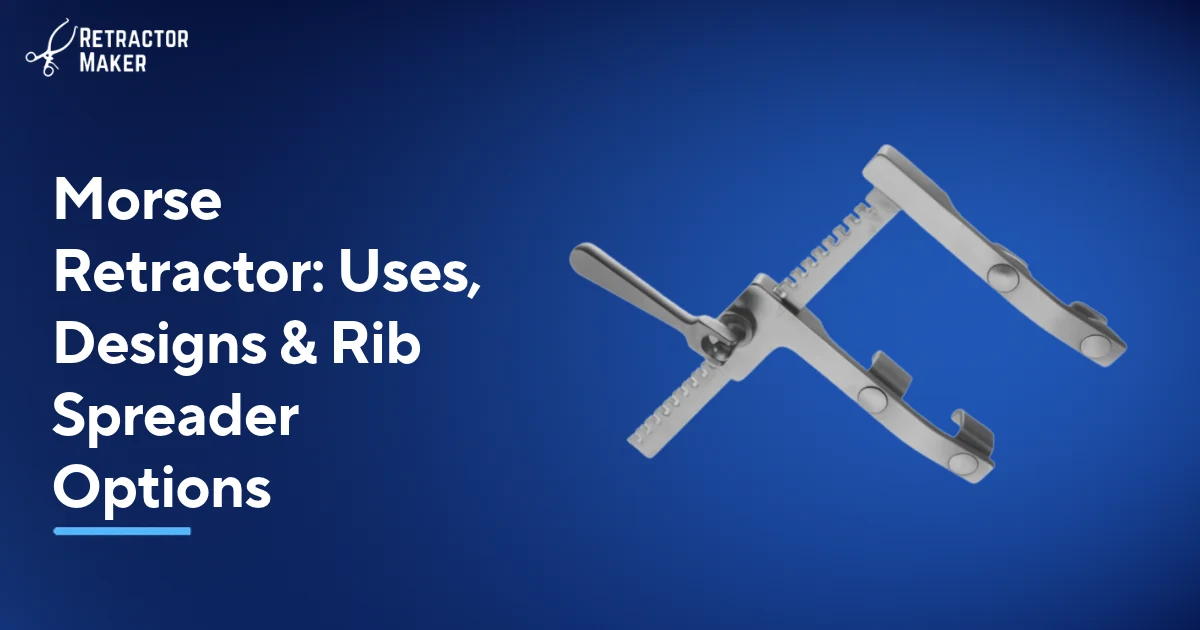
Compare Morse retractor designs, blade sizes, uses and sterilization considerations, with buying guidance for surgical teams and hospital procurement.
Retractors discussed in this guide: Morse Rib Spreader, Morse-Favaloro Rib Spreader. Browse all surgical retractors.
A Morse retractor is a surgical rib spreader used to separate ribs and expand the thoracic cavity during open thoracic procedures. Its movable blades accommodate rib anatomy, while a guide rail and screw-lock mechanism support maintained expansion. For surgical teams and hospital buyers, the important distinctions are the intended procedure, blade dimensions, available spread and handling characteristics. Retractor Maker supplies the Morse Rib Spreader and Morse-Favaloro Rib Spreader; these related instruments should be compared by their documented specifications rather than treated as interchangeable.
What is a Morse retractor?
The Morse retractor is a mechanical rib-spreading instrument, rather than a handheld soft-tissue retractor. Its blades engage the operative opening to support rib separation, and the locking mechanism maintains the selected expansion. This provides exposure while allowing the surgical team to work within the thoracic cavity.
In this product range, both models use a parallel slide guide rail and movable blades. Their shared purpose is controlled rib separation, but their documented applications and dimensions differ. A product name alone does not establish suitability for a particular approach: the surgeon must consider the planned exposure, patient anatomy and the specific instrument configuration.
What is a Morse retractor used for?
The Morse Rib Spreader is intended for separating ribs and expanding the thoracic cavity during open thoracotomy. The Morse-Favaloro Rib Spreader is intended for rib separation during coronary artery bypass and thoracic surgery. These are the documented applications for the supplied products, not a claim that either model suits every operation within those specialties.
- Open thoracotomy: the Morse Rib Spreader provides rib separation with multi-position anatomical blade adjustment.
- Thoracic surgery: both products offer movable blade configurations for adapting contact to rib anatomy.
- Coronary artery bypass: the Morse-Favaloro Rib Spreader is specifically listed for rib separation in this setting.
- Operating-room preparation: confirm the requested model and size against the surgeon's planned approach before assembling the instrument tray.
The operative approach determines whether a rib spreader is appropriate. A rib-spreading indication should not be interpreted as an indication for every form of chest access. Instrument selection remains a clinical decision, and procurement teams should obtain the surgeon's requirements rather than substitute a model solely because its name or appearance is similar.
How do the blades, guide rail and lock work?
Movable blades provide anatomical adjustment, the parallel rail guides separation, and the screw lock maintains expansion. The Morse Rib Spreader has 4 movable angled blades, with 2 per shank, designed to swivel and adapt to varying rib anatomy. Its integrated turning screw lock uses a manually rotated threaded bolt to maintain rigid expansion.
The Morse chassis includes a lightweight parallel guide rail beam and ergonomic extension arms forged with smooth soft-tissue margins. Its blades are made from Premium Grade AISI 304/316 Stainless Steel (Non-Magnetic). These design details describe the instrument; they do not eliminate the need for careful tissue protection or continuous assessment during retraction.
The Morse-Favaloro model has 4 movable swiveling blades and a turning thread screw lock. Its listed primary material is Premium Grade AISI 304/316 Stainless Steel (Non-Magnetic), while its guide rail is specifically described as lightweight aluminum. Tapered handle shanks have smooth outer edges. Buyers should therefore avoid assuming that every component is made from the same material.
Which Morse retractor types and sizes are available?
Retractor Maker offers the Morse Rib Spreader in multiple sizing options and the Morse-Favaloro Rib Spreader with its own documented blade dimensions and maximum expansion. Compare the intended use and blade configuration before comparing spread alone.
| Product | Design | Typical use | Documented dimensions |
|---|---|---|---|
| Morse Rib Spreader | Parallel slide guide rail; 4 movable angled blades, 2 per shank; integrated turning screw lock | Rib separation and thoracic cavity expansion during open thoracotomy | Blade options: 22×27 mm, 30×28 mm, 42×28 mm and 55×28 mm; spread: 200 mm or 210 mm, depending on option |
| Morse-Favaloro Rib Spreader | Parallel slide guide rail; 4 movable swiveling blades; turning thread screw lock; lightweight aluminum guide rail | Rib separation during coronary artery bypass and thoracic surgery | 17 mm × 22 mm movable lateral blades; maximum horizontal spread of 160 mm |
Morse Rib Spreader sizing options
| Option | Blade dimensions | Spread | Listed price |
|---|---|---|---|
| Option A | 22×27 mm | 200 mm | $239 |
| Option B | 30×28 mm | 210 mm | $259 |
| Option C | 42×28 mm | 210 mm | $279 |
| Option D | 55×28 mm | 210 mm | $299 |
A larger available spread is a capacity specification, not a recommended intraoperative opening. Blade dimensions and anatomical fit matter independently of rail travel. Confirm current pricing, the selected configuration and any shipping charges when requesting a quotation. No price is provided here for the Morse-Favaloro model because none is included in the supplied specifications.
How should a Morse retractor be positioned?
Positioning should be performed by trained surgical personnel under the operating surgeon's direction and according to the instrument instructions. The general goal is stable blade contact with appropriate tissue protection, using only the exposure required for the procedure. This overview is not a substitute for operative training or model-specific instructions.
- Before use, check blade movement, rail travel and screw-lock function; remove damaged or malfunctioning instruments from service.
- Confirm that the chosen blade dimensions and available spread match the planned exposure.
- Ensure that blades are seated appropriately and that vulnerable soft tissue is not trapped.
- Apply retraction gradually under direct surgical assessment, monitoring blade position and tissue response.
- Reassess exposure during the procedure and release retraction in a controlled manner when directed.
Movable blades allow adjustment, but they do not automatically establish safe positioning. Excessive or poorly distributed force can injure ribs and surrounding tissues. The team should not continue expansion merely because additional rail travel remains available, and a lock that does not maintain the intended position requires attention rather than improvised compensation.
How is a Morse retractor cleaned and sterilized?
Both products are supplied non-sterile and are fully autoclavable. Individual Protective Packaging protects the instrument during handling and transport; it is not evidence of sterility. Appropriate cleaning, inspection and sterilization are required before clinical use, following the manufacturer's instructions and the facility's validated reprocessing procedures.
Reprocessing should address areas where debris may remain, including blade pivots, guide surfaces and screw threads. Clean before sterilizing, then inspect for residual soil, damage and impaired movement. Follow manufacturer guidance on compatible cleaning agents, any required disassembly and lubrication. The Morse-Favaloro model's aluminum guide rail should be considered when confirming cleaning chemistry compatibility.
The supplied specifications do not provide a sterilization temperature, exposure time or drying cycle. Do not infer those parameters from the phrase fully autoclavable. Obtain the model-specific reprocessing instructions before introducing either instrument into service, and use the facility's established procedures for packaging, cycle verification, storage and release of sterilized instruments.
How do you choose and buy from Retractor Maker?
Choose the model by intended procedure, blade fit, expansion requirements and reprocessing compatibility. Retractor Maker is a surgical retractor manufacturer and exporter in Sialkot, Pakistan, offering wholesale supply, OEM services and worldwide shipping. Both listed products are brand new, individually protectively packaged and available with a minimum order quantity of 1 Set.
For a purchasing enquiry, state the product name, Morse sizing option where applicable, required quantity and delivery destination. For OEM requests, describe the requested specifications and ask what can be supplied rather than assuming a particular modification is available. Request confirmation of component materials, current commercial terms and model-specific care instructions so surgical, procurement and sterile processing teams can review the same information.
Clinical notice: This guide is for surgical teams and hospital buyers. Always follow the manufacturer's instructions for use (IFU) and your hospital's sterilization rules before clinical use.
Frequently Asked Questions
What is a Morse retractor used for?
A Morse retractor is used to separate ribs and provide thoracic exposure. The Morse Rib Spreader is documented for open thoracotomy, while the Morse-Favaloro Rib Spreader is documented for coronary artery bypass and thoracic surgery. The appropriate model depends on the operative approach, required exposure and patient anatomy.
What is the difference between Morse and Morse-Favaloro rib spreaders?
The Morse and Morse-Favaloro rib spreaders differ in their documented applications, blade dimensions and expansion capacity. The Morse offers multiple blade options with 200 mm or 210 mm spread. The Morse-Favaloro has 17 mm × 22 mm movable lateral blades, a maximum horizontal spread of 160 mm and a lightweight aluminum guide rail.
What sizes does the Morse retractor come in?
The Morse Rib Spreader comes in four documented sizing options. Option A has 22×27 mm blades and 200 mm spread; Options B, C and D have 30×28 mm, 42×28 mm and 55×28 mm blades respectively, each with 210 mm spread. These capacities should not be treated as recommended clinical opening distances.
Can a Morse retractor be autoclaved?
Both listed Morse rib spreaders are fully autoclavable and supplied non-sterile. Cleaning and inspection must precede sterilization, and protective packaging does not establish sterility. Because cycle parameters are not included in the supplied specifications, obtain the manufacturer's model-specific instructions and follow the facility's validated reprocessing procedures before clinical use.
What material is a Morse retractor made from?
The Morse Rib Spreader blades are made from Premium Grade AISI 304/316 Stainless Steel (Non-Magnetic). The Morse-Favaloro lists the same primary material but separately specifies a lightweight aluminum guide rail. Component-specific material information matters when assessing cleaning compatibility, so buyers should not assume that the entire assembly has a uniform material composition.
Where can hospitals buy a Morse retractor?
Hospitals can enquire directly with Retractor Maker in Sialkot, Pakistan, for Morse and Morse-Favaloro rib spreaders. The manufacturer and exporter offers wholesale supply, OEM services and worldwide shipping. Both products have a minimum order quantity of 1 Set; specify the model, applicable size, quantity and destination when requesting a quotation.
About the author
Saad Shahid · Sales & Marketing Manager
Saad Shahid is the Sales & Marketing Manager and founder of Retractor Maker, started in 2023 in Sialkot, Pakistan. He also works with his father at Hospitech Traders, the family surgical instrument business founded in 1989.
Related Blogs & Guide
Related Retractors
All Retractors


Need Surgical Retractors or Components?
Tell us what you need, including the product, configuration, quantity and destination country. Retractor Maker can provide availability, specifications and pricing.
Request a Quote