
ENT Retractors
Cottle Retractor: Uses, Types, Sizes & Buying Guide
Author: Saad Shahid · Updated · 7 min read
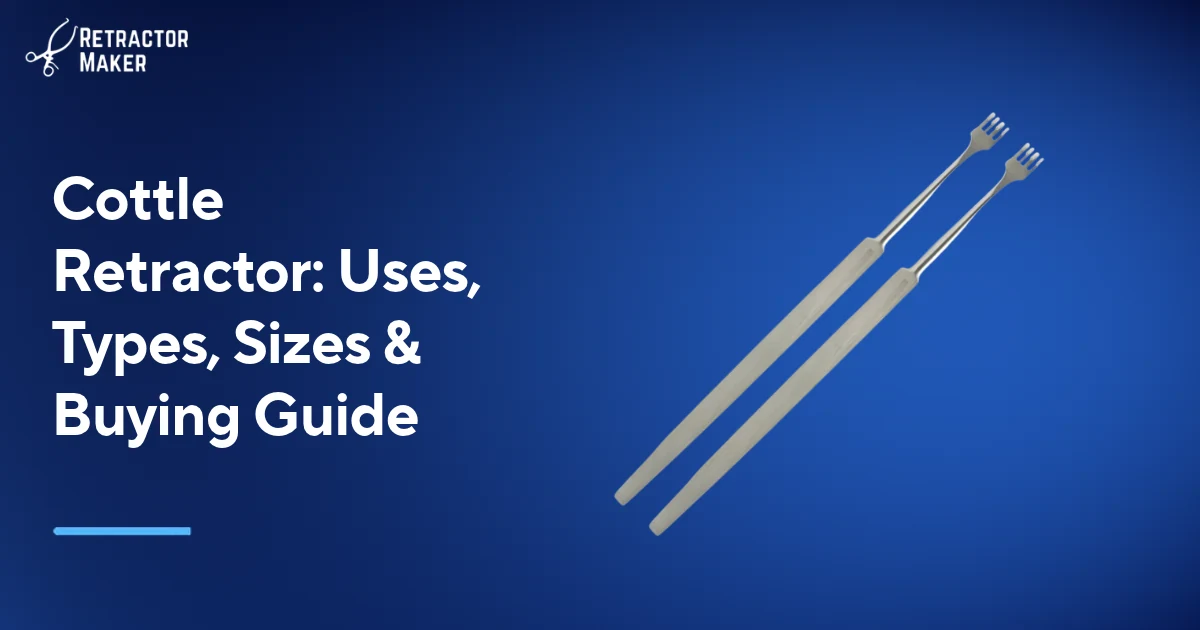
Compare Cottle retractor types, sizes, tip designs, surgical uses, and sterilization considerations, with buying guidance from Retractor Maker in Sialkot.
Retractors discussed in this guide: Cottle Alar Nasal Retractor / Hook, Cottle Nasal Retractor - 4 Blunt Prongs, Cottle Retractor Hook 2 Prong, Millard Cottle Retractor with Finger Ring. Browse all surgical retractors.
A Cottle retractor is a handheld surgical instrument used to hold nasal and facial tissues away from the operative field. Depending on its configuration, it retracts skin flaps, mucosa, cartilage, the alar rim, or nostril margins. Selecting the appropriate design requires attention to the target tissue, tip geometry, working-end dimensions, and preferred grip. This guide compares the Cottle instruments supplied by Retractor Maker and explains practical selection and handling considerations for surgeons, operating room staff, and hospital purchasing teams.
What is a Cottle retractor?
A Cottle retractor provides manual tissue retraction rather than self-retaining exposure. The surgeon or assistant holds the instrument and adjusts traction as the operative view changes. Its working end engages the selected tissue while the handle allows controlled positioning. The name covers several related configurations, so specifying only “Cottle retractor” may not identify the instrument needed for a particular tray.
The supplied range includes a selectable-tip hook, a blunt nasal rake, an asymmetric alar hook, and a compact finger-ring instrument. These designs differ in tissue contact and handling. They should not be treated as interchangeable simply because they share the Cottle name. Matching the instrument to the planned exposure helps the surgical team communicate clearly during preparation and use.
What is a Cottle retractor used for?
Cottle retractors are used for exposure during rhinoplasty, facial plastic surgery, and selected nasal reconstructive procedures. Specific indications vary by model. The supplied blunt nasal rake also lists septoplasty, while the Millard Cottle design lists cleft lip nasal repairs. Selection should follow the operative plan rather than assuming every model supports every procedure.
- Skin flaps, mucosa, and cartilage: the Cottle Retractor Hook 2 Prong is intended for rhinoplasty and facial plastic surgery.
- Alar rim, columella, and vestibular mucosa: the Cottle Nasal Retractor - 4 Blunt Prongs is intended for rhinoplasty and septoplasty.
- Alar rim and nostril margins: the Cottle Alar Nasal Retractor / Hook is intended for aesthetic and reconstructive rhinoplasty.
- Alar rim and lower lateral cartilage: the Millard Cottle Retractor with Finger Ring is intended for rhinoplasty and cleft lip nasal repairs.
Retraction supports visualization; it does not replace dissection or tissue assessment. During exposure, the operator must balance visibility against tissue tension. Nasal and facial tissues require careful handling, and even a blunt working end can cause injury if excessive force or prolonged pressure is applied.
How do the parts and tip designs differ?
The main design differences are the prong arrangement, working-end profile, and handle. The hook, blunt nasal rake, and hybrid alar models have flat ergonomic handles with lateral serrations for tactile grip stability. The Millard Cottle model instead uses an integrated finger ring at the base for manual traction.
Working ends and tissue contact
The Cottle Retractor Hook 2 Prong offers Ball End or Sharp End prongs. The blunt nasal rake has polished blunt tips and recessed outside prongs for anatomical contouring. The alar hook combines one blunt ball-end prong with one sharp prong, with Ball on Left Side and Ball on Right Side options. The Millard Cottle has a sharp double-prong blade. These distinctions matter when planning the contact point and direction of traction.
Material and handling format
All listed models use Premium Grade AISI 304/316 Stainless Steel (Non-Magnetic). Overall length alone does not describe their handling: the finger-ring model has a different grip format from the flat-handled designs. Buyers should review the working-end measurements alongside handle configuration, rather than selecting by instrument length alone.
Which Cottle retractor types and sizes are available?
Retractor Maker lists the following Cottle configurations. The comparison preserves the supplied dimensions and separates selectable tip options from distinct instrument designs. Confirm the complete product name and requested option when preparing a purchase order or replacement list.
| Product name | Design and size | Typical use |
|---|---|---|
| Cottle Retractor Hook 2 Prong | Handheld 2-prong hook; Ball End or Sharp End; 6 ¾″ (171 mm) overall; 12 mm wide framework; flat serrated handle. | Retraction of skin flaps, mucosa, and cartilage during rhinoplasty and facial plastic surgery. |
| Cottle Nasal Retractor - 4 Blunt Prongs | Handheld blunt nasal rake with recessed outside prongs; 6″ (15.0 cm) overall; 10.0 mm wide rake head; flat serrated handle. | Retraction of the alar rim, columella, and vestibular mucosa during rhinoplasty and septoplasty. |
| Cottle Alar Nasal Retractor / Hook | Hybrid ball-end and sharp prongs; Ball on Left Side or Ball on Right Side; 5 ½″ (14.0 cm) overall; 10.0 mm wide; flat serrated handle. | Retraction of the alar rim and nostril margins during aesthetic and reconstructive rhinoplasty. |
| Millard Cottle Retractor with Finger Ring | Compact integrated finger-ring design; 5.5 cm (approx. 2.16 inches) overall; 5 mm wide × 12 mm long sharp double-prong blade. | Retraction of the alar rim and lower lateral cartilage during rhinoplasty and cleft lip nasal repairs. |
How is a Cottle retractor positioned safely?
A Cottle retractor should be positioned under direct visualization by trained surgical personnel, using only the traction needed for exposure. The contact site and direction depend on the tissue, procedure, and selected tip geometry. This overview is not a substitute for surgical training or the manufacturer's instructions for use.
- Confirm the requested model and tip orientation before passing the instrument.
- Inspect the working end and handle for damage or deformation before use.
- Identify the intended tissue contact site and keep adjacent structures clear.
- Apply controlled manual traction while monitoring tissue response and operative visibility.
- Ease traction before repositioning; avoid dragging sharp tips across tissue.
- Coordinate changes in exposure between the surgeon and assistant.
Blunt tips do not eliminate the need for careful force control. Sharp and hybrid tips require particular attention to unintended contact during placement, transfer, and removal. Reassess the retraction when the operative task changes rather than maintaining unnecessary tension.
How should Cottle retractors be cleaned and sterilized?
All listed Cottle retractors are supplied non-sterile and are fully autoclavable. They require appropriate processing before surgical use, including initial use. Individual Protective Packaging protects the supplied instrument but does not establish sterility.
Cleaning must precede sterilization. Follow the manufacturer's validated reprocessing instructions and the facility's sterile processing procedures for soil removal, rinsing, drying, inspection, packaging, and steam sterilization. Pay attention to prongs, serrations, and the finger-ring area where applicable. Protect working ends during handling and loading to reduce damage and sharps exposure.
The supplied product information does not specify a validated autoclave cycle, cleaning chemistry, or exposure time. Request the applicable instructions before processing rather than selecting parameters from the material description. Remove damaged instruments from service and refer them for assessment under facility policy.
How do you choose and buy from Retractor Maker?
Choose the model by intended tissue, procedure, tip configuration, and grip preference. For replacement orders, match the existing approved tray specification rather than relying on a generic instrument name. Record the full product name, dimensions, and any selectable option so purchasing and operating room teams use the same description.
Retractor Maker is a surgical retractor manufacturer and exporter in Sialkot, Pakistan, offering wholesale supply, OEM services, and worldwide shipping. The listed instruments are brand new, individually protectively packaged, and available with a minimum order quantity of 1 Piece. Request a quotation covering the selected configurations, quantities, shipping destination, and any OEM requirements.
Before ordering, confirm current pricing, availability, delivery terms, and the required processing documentation. For the alar hook, specify the ball-end side explicitly. For the standard hook, specify Ball End or Sharp End. Discuss any requested OEM changes separately rather than assuming they are included in the listed specifications.
Clinical notice: This guide is for surgical teams and hospital buyers. Always follow the manufacturer's instructions for use (IFU) and your hospital's sterilization rules before clinical use.
Frequently Asked Questions
What is a Cottle retractor used for?
A Cottle retractor is used to retract nasal or facial tissues for surgical exposure. Depending on the model, its intended applications include rhinoplasty, facial plastic surgery, septoplasty, and cleft lip nasal repairs. The target tissue may be skin flaps, mucosa, cartilage, the alar rim, columella, or nostril margins, so the specific configuration matters.
What is the difference between a Cottle hook and a blunt nasal retractor?
The listed Cottle hook has selectable Ball End or Sharp End prongs, while the blunt nasal retractor has a rake head with recessed outside prongs. The hook is intended for skin flaps, mucosa, and cartilage in rhinoplasty and facial plastic surgery. The blunt nasal model targets the alar rim, columella, and vestibular mucosa in rhinoplasty and septoplasty.
What sizes do Cottle retractors come in?
The listed Cottle instruments have different overall lengths and working-end dimensions. The standard hook is 6 ¾″ (171 mm), the blunt nasal rake is 6″ (15.0 cm), and the alar hook is 5 ½″ (14.0 cm). The Millard Cottle finger-ring model is 5.5 cm (approx. 2.16 inches). Compare head or blade measurements as well as overall length.
Are Cottle retractors supplied sterile?
These Cottle retractors are supplied non-sterile and require processing before surgical use. Each listed model is fully autoclavable and comes in Individual Protective Packaging, which is not a sterile barrier claim. Obtain the manufacturer's validated reprocessing instructions and follow facility procedures for cleaning, inspection, packaging, and sterilization before initial use and subsequent reuse.
How do I choose the left or right Cottle alar hook?
Choose the Cottle alar hook's ball-end side according to the planned anatomical alignment and traction direction. This model combines one blunt ball-end prong with one sharp prong and offers Ball on Left Side or Ball on Right Side options. Confirm the requested orientation with the operating surgeon and supplier rather than inferring it solely from the operative side.
Can hospitals order Cottle retractors wholesale from Pakistan?
Hospitals can request wholesale Cottle retractor quotations from Retractor Maker in Sialkot, Pakistan. The company manufactures and exports surgical retractors, offers OEM services, and ships worldwide. Provide the product names, tip options, quantities, and destination when requesting a quotation, and confirm availability, delivery terms, and processing documentation before placing the order.
About the author
Saad Shahid · Sales & Marketing Manager
Saad Shahid is the Sales & Marketing Manager and founder of Retractor Maker, started in 2023 in Sialkot, Pakistan. He also works with his father at Hospitech Traders, the family surgical instrument business founded in 1989.
Related Blogs & Guide


Related Retractors

Brunner Retractor
From $54.00
Weitlaner Retractor
From $94.00

Ring Breast Retractor With Fiber Optic Illumination
$339
Wide Self-Retaining Retractor
$139
Sauerbruch Retractor
From $69.00
Richardson Eastman Retractor
From $54.00
Need Surgical Retractors or Components?
Tell us what you need, including the product, configuration, quantity and destination country. Retractor Maker can provide availability, specifications and pricing.
Request a Quote