
Cardiovascular Retractors
Bailey Rib Contractor: Uses, Design & Buying Guide
Author: Saad Shahid · Updated · 7 min read
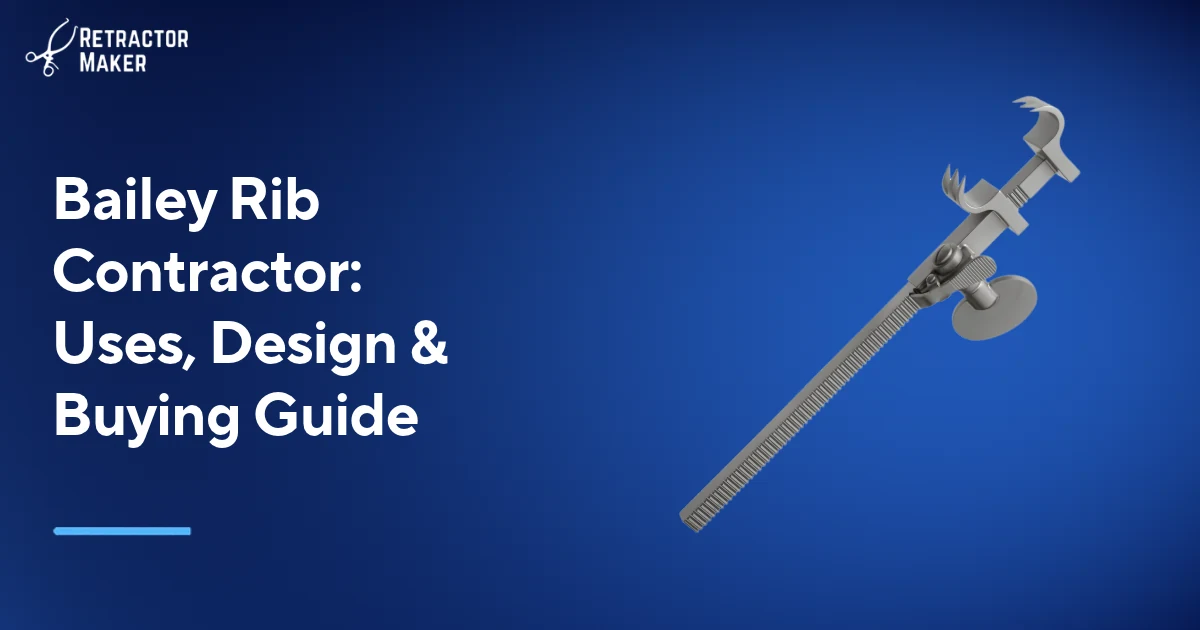
Learn how a Bailey rib contractor supports thoracotomy closure, including its design, positioning principles, sterilization, and purchasing options.
Retractors discussed in this guide: Bailey Rib Contractor. Browse all surgical retractors.
A Bailey rib contractor is a handheld mechanical screw-driven instrument designed to approximate adjacent ribs and stabilize the thoracic cage during thoracotomy wound closure. It brings rib borders toward one another rather than spreading them apart. For surgeons, its role is controlled rib alignment during pericostal suturing; for OR teams and hospital buyers, the main considerations are its gripping design, screw mechanism, supplied sterility status, and compatibility with local reprocessing workflows. This guide explains the listed Retractor Maker instrument and distinguishes documented specifications from details that buyers should confirm before ordering.
What is a Bailey rib contractor?
The Bailey rib contractor is a rib approximator used during closure of a thoracotomy incision. Its curved claw-like tips grip rib borders, and its threaded thumbscrew provides gradual compression. The aim is to support rib alignment while the surgeon carries out closure, not to replace sutures or function as a permanent implant.
The distinction between a contractor and a retractor matters when selecting a thoracic instrument set. A rib retractor spreads ribs to maintain surgical access; a rib contractor brings adjacent ribs closer during closure. These instruments serve different stages of an operation and should not be treated as interchangeable. Procurement descriptions should state the intended action clearly, especially when ordering instruments from a broad retractor catalog.
What is a Bailey rib contractor used for?
Its documented use is approximation of ribs and stabilization of the thoracic cage during thoracotomy wound closure. The instrument supports alignment during pericostal suturing, in which sutures are placed around ribs as part of the selected closure technique. Its relevance is therefore defined by the surgical approach and closure requirement, rather than by a particular diagnosis.
Thoracic surgical teams may include a rib contractor in an instrument set when planned closure requires rib approximation. Cardiothoracic teams using a thoracotomy approach may have the same requirement. The supplied product information does not establish separate indications for fracture fixation, chest wall reconstruction, or other procedures; those uses should not be assumed from the instrument name.
- Primary task: bring adjacent ribs toward one another during thoracotomy closure.
- Supporting role: maintain rib alignment during pericostal suturing.
- Selection principle: match the instrument to the planned closure technique and patient anatomy.
- Scope limit: do not substitute this contractor for a rib spreader or an implanted fixation system.
What are its design, parts, and specifications?
The listed instrument combines curved claw-like gripping tips with a mechanical threaded thumbscrew compressor. The tips are designed to grip rib borders securely, while the screw permits gradual rib approximation. This arrangement allows the operator to adjust compression progressively rather than relying on a single abrupt closing movement. Actual engagement and compression remain matters of surgical judgment.
The overall length is 20 cm (approx. 8 inches). The specified material is Premium Grade AISI 304/316 Stainless Steel (Non-Magnetic). Overall length describes the instrument, not its opening capacity or the dimensions of its gripping tips. Those additional measurements are not provided in the listing and should be requested if required for instrument-set compatibility or a purchasing specification.
- Configuration: handheld mechanical screw-driven rib contractor / approximator.
- Tip architecture: strong curved claw-like tips designed to grip rib borders securely.
- Tension mechanism: mechanical threaded thumbscrew compressor for gradual rib approximation.
- Sterility: supplied non-sterile and fully autoclavable.
- Packaging and condition: individual protective packaging; brand new.
Which Bailey rib contractor variants are listed?
Only one Bailey Rib Contractor configuration is documented in the supplied product information. The table summarizes that product without implying that additional lengths, tip profiles, or mechanisms are available. A comparison with other contractor patterns requires their own specifications; names alone are not enough to establish equivalent performance or suitability.
| Product name | Design | Listed length | Typical use |
|---|---|---|---|
| Bailey Rib Contractor | Handheld screw-driven approximator with curved claw-like tips and a threaded thumbscrew compressor | 20 cm (approx. 8 inches) | Adjacent rib approximation and thoracic cage stabilization during thoracotomy wound closure |
For buyers comparing quotations, the important distinctions are the documented gripping configuration, compression mechanism, overall dimensions, and reprocessing requirements. Do not interpret an OEM service offering as confirmation of an existing alternative model. If a different configuration is needed, obtain a written specification and confirmation of availability before including it in an approved purchase.
How is a Bailey rib contractor positioned and used?
A trained surgeon positions the gripping tips on the intended rib borders and uses gradual screw adjustment to support alignment during closure. This is a general positioning principle, not an operative protocol. Selection of the contact sites, acceptable approximation, and closure sequence depends on the exposure, tissue condition, patient anatomy, and the surgeon's technique.
Before use, the team should confirm that the instrument has been appropriately reprocessed and that its tips and screw mechanism are intact and functioning. During placement, surrounding soft tissues and the intercostal neurovascular structures require protection. Secure engagement must be assessed under direct visualization; increasing compression is not a substitute for correcting an unsuitable position.
Compression should be controlled and reassessed as the ribs approach the intended alignment. Unexpected resistance, slipping, or concern for tissue injury calls for reassessment rather than additional force. Release and removal should be coordinated with the closure technique so that the instrument does not disrupt sutures or catch adjacent tissues. Follow the applicable instructions for use and institutional surgical practice.
How should it be cleaned and sterilized?
The Bailey Rib Contractor is supplied non-sterile and is fully autoclavable. It therefore requires appropriate cleaning and sterilization before clinical use, including its first use. Individual protective packaging protects the product during handling and transport; it does not establish a sterile barrier or make the instrument ready for the sterile field.
Reprocessing must follow the manufacturer's validated instructions and the facility's sterile processing procedures. General priorities include removal of soil, attention to the threaded mechanism and gripping surfaces, inspection for damage or retained debris, and adequate drying. A damaged or poorly functioning instrument should be removed from service for assessment rather than returned to the operative set.
The supplied listing does not provide a validated cleaning method, disassembly instructions, detergent compatibility, lubrication requirements, or autoclave cycle parameters. Fully autoclavable does not mean that any steam cycle is acceptable. Request the current reprocessing instructions before clinical deployment, and have sterile processing staff confirm that the required process can be performed within the facility.
How do you choose and buy from Retractor Maker?
Choose a Bailey rib contractor by matching its documented closure function and configuration to the surgical team's requirements. The listed manufacturer is Retractor Maker, a surgical retractor manufacturer and exporter in Sialkot, Pakistan, offering wholesale supply, OEM services, and worldwide shipping. The minimum order quantity for this product is 1 Piece.
A purchase inquiry should identify the Bailey Rib Contractor and reference the product slug bailey-rib-contractor. Confirm the listed length, material wording, non-sterile supply status, and individual protective packaging in the quotation. Ask for any additional dimensions, current instructions for use, and documentation required by your hospital or destination market.
For wholesale or OEM orders, separate confirmed product specifications from requested modifications. Obtain written agreement on the order scope, labeling or packaging requests, availability, shipping arrangements, and delivery terms. Surgical users, procurement staff, and sterile processing personnel should review their respective requirements before approval, so the purchase fits both the operative need and the hospital's processing workflow.
Clinical notice: This guide is for surgical teams and hospital buyers. Always follow the manufacturer's instructions for use (IFU) and your hospital's sterilization rules before clinical use.
Frequently Asked Questions
What is a Bailey rib contractor used for?
A Bailey rib contractor is used to approximate adjacent ribs and stabilize the thoracic cage during thoracotomy wound closure. Its curved claw-like tips grip rib borders, while a threaded thumbscrew provides gradual compression for alignment during pericostal suturing. It supports the closure process rather than replacing sutures or acting as a permanent fixation implant.
What is the difference between a rib contractor and a rib retractor?
A rib contractor brings ribs closer together, whereas a rib retractor spreads ribs apart for surgical access. The Bailey Rib Contractor is intended for the closure stage of a thoracotomy. Hospital buyers should distinguish these functions in instrument specifications because a shared thoracic application does not make the instruments interchangeable.
What size is the Bailey Rib Contractor?
The listed Bailey Rib Contractor has an overall length of 20 cm (approx. 8 inches). The supplied information documents only this configuration and does not specify opening capacity, tip dimensions, or alternative sizes. Buyers who need those measurements for a surgical set or tender should request confirmation from Retractor Maker before ordering.
Is the Bailey Rib Contractor supplied sterile?
The Bailey Rib Contractor is supplied non-sterile in individual protective packaging. It must undergo appropriate cleaning and sterilization before clinical use, including first use. Although the product is fully autoclavable, the listing does not provide cycle parameters; sterile processing teams should obtain and follow the manufacturer's validated reprocessing instructions.
What material is the Bailey Rib Contractor made from?
The specified material is Premium Grade AISI 304/316 Stainless Steel (Non-Magnetic). Buyers should retain this exact wording when referencing the listed product in a quotation or procurement request. If a tender requires more specific material documentation, request it from the manufacturer rather than inferring details not stated in the product listing.
Where can hospitals buy a Bailey Rib Contractor?
Hospitals can inquire about the Bailey Rib Contractor from Retractor Maker in Sialkot, Pakistan. The manufacturer offers wholesale supply, OEM services, and worldwide shipping, and the listed minimum order quantity is 1 Piece. Confirm the product specifications, reprocessing documentation, availability, destination requirements, and shipping terms before approving an order.
About the author
Saad Shahid · Sales & Marketing Manager
Saad Shahid is the Sales & Marketing Manager and founder of Retractor Maker, started in 2023 in Sialkot, Pakistan. He also works with his father at Hospitech Traders, the family surgical instrument business founded in 1989.
Related Blogs & Guide


Related Retractors

Ross Aortic Valve Retractor
From $89.00

Baby-Haight Rib Spreader
$289
Burford Rib Spreader
From $359Free Shipping

Haight Rib Spreader
$329
Sauerbruch Retractor
From $69.00
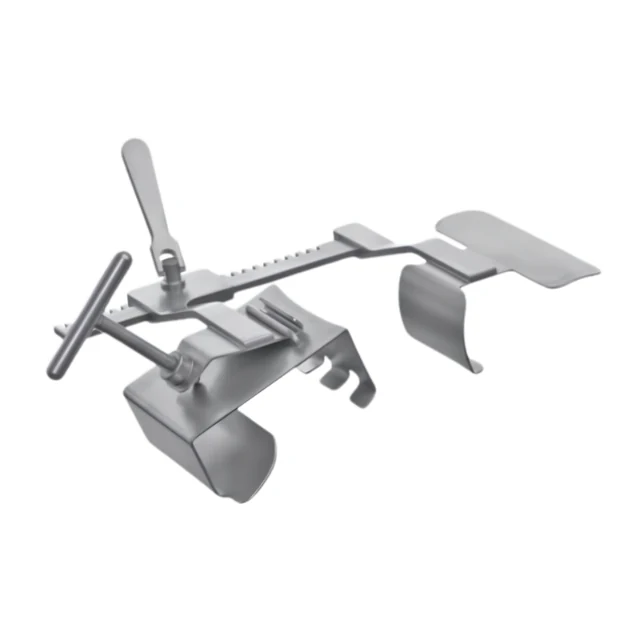
Bugge Takedown I.M.A Mammaria Retractor
$499Free Shipping
Need Surgical Retractors or Components?
Tell us what you need, including the product, configuration, quantity and destination country. Retractor Maker can provide availability, specifications and pricing.
Request a Quote