
General Surgery Retractor Guides
What Is an Army-Navy Retractor? Uses, Design & Features
Reviewed by Retractor Maker technical team · Updated
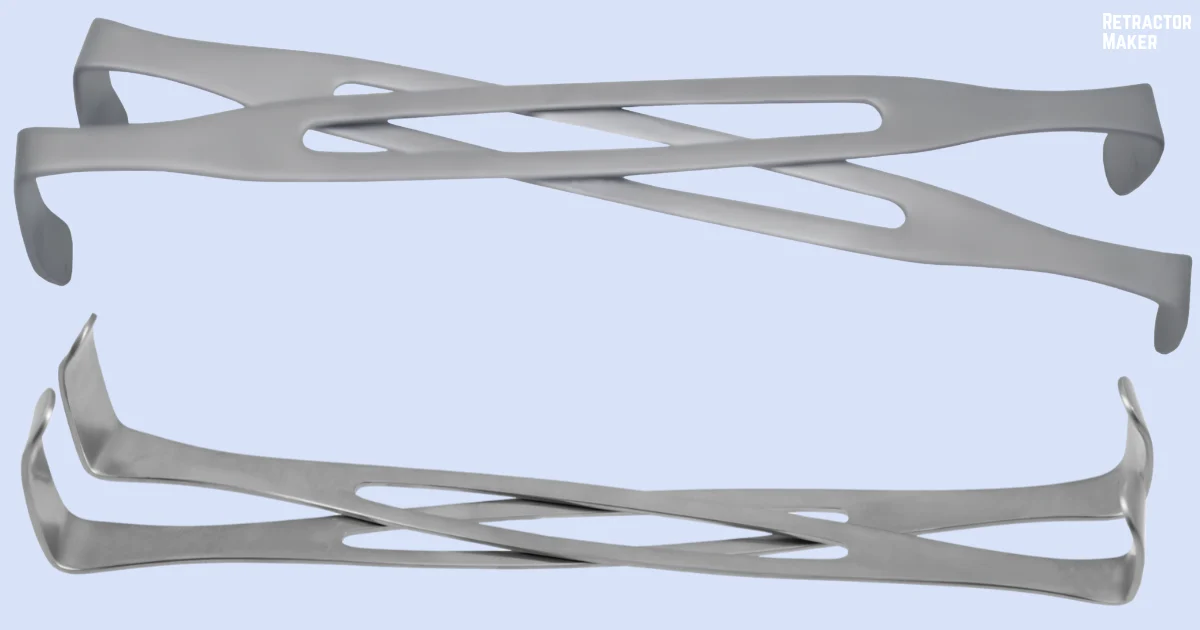
In open surgical procedures, establishing and maintaining an unobstructed operative corridor is necessary for procedural safety, visual illumination, and tissue identification. While deep-cavity surgical procedures frequently require complex self-retaining frames, minor incisions and initial surgical dissections rely heavily on responsive handheld instrumentation.
An Army-Navy retractor (commonly referred to as an "US Army" or "Army-Navy" retractor) is a foundational, double-ended handheld surgical instrument designed to retract skin, subcutaneous fat, muscle layers, and connective tissue. Characterized by its flat central handle and right-angled, dissimilar blades on opposing ends, the Army-Navy retractor is widely utilized across general surgery, orthopedics, and minor operative trays worldwide.
Contents
What Is an Army-Navy Retractor?
An Army-Navy retractor is a rigid, manual surgical retractor configured with functional working blades at both extremities of a central shaft. Unlike self-retaining retractors that maintain tissue tension through mechanical ratchets, frames, or thumbscrews, an Army-Navy retractor requires continuous positioning and tension control by an operating assistant or surgeon.
The defining characteristics of an Army-Navy retractor include:
- Double-Ended Design: Both ends feature smooth, right-angled (90-degree) blades with slightly curved retaining lips.
- Asymmetrical Blades: To maximize procedural utility, the two blades are manufactured with different depths and lengths—typically featuring one shorter, shallower blade for superficial dermal retraction and one longer, deeper blade for intermediate subcutaneous or muscular exposure.
- Fenestrated Central Handle: The central shaft features an oblong fenestration (cutout hole) that reduces overall instrument weight while providing a tactile, non-slip grip for gloved hands.
- Atraumatic Geometry: All blade margins, lips, and side edges are smooth and radiused to distribute counter-traction evenly, minimizing focal pressure necrosis or accidental laceration of friable soft tissues.
Army-Navy Retractor Design and Features
The operational simplicity of the Army-Navy retractor conceals precise engineering parameters developed to withstand routine mechanical stress during wound retraction.
Blade Configuration & Functional Geometry
The instrument features two flat, right-angled blades projecting from the same side of the shaft. Each blade terminates in a shallow, inward-curving lip:
- The Superficial Blade: Measures shorter in reach, allowing surgical assistants to engage cuticular and subcutaneous fat layers without impinging on deeper neurovascular pathways.
- The Intermediate Blade: Projects further downward, designed to seat against deeper fascial planes, aponeuroses, or muscle bellies.
Handle Architecture & Balance
The central body functions as both a handle and a structural stabilizer. The central opening (fenestration) serves two practical roles: it allows the assistant to hook a finger through the shaft for directional stability and serves as an attachment or hanging point during instrument processing.
Material Construction & Finish
Surgical Army-Navy retractors are manufactured from medical-grade stainless steel to resist corrosion, tensile deformation, and structural fatigue. They are finished with a satin or matte passivation layer to eliminate glare under high-intensity operating lights.
What Is an Army-Navy Retractor Used For?
The Army-Navy retractor is primarily used in surgical procedures requiring manual retraction of superficial to intermediate soft-tissue layers:
- Initial Wound Opening & Laparotomy Entry: Following the primary skin incision, assistants deploy the shallow blade to hold cuticular margins back, allowing clear visualization of the linea alba or superficial fascia.
- Soft-Tissue Mass Excision: During the removal of lipomas, sebaceous cysts, or enlarged lymph nodes, the smooth blades gently elevate subcutaneous fat planes away from the surgical capsule.
- Superficial Orthopedic Approaches: Used to displace subcutaneous tissue and muscular boundaries during fracture repair, hardware removal, or tendon exposure on the extremities (such as the forearm, fibula, or clavicle).
- Hernia Repairs: Provides steady exposure of the external oblique aponeurosis, inguinal canal, and superficial inguinal ring during open inguinal or umbilical herniorrhaphies.
- Plastic & Reconstructive Surgery: Stabilizes cutaneous margins and donor sites where broad, uniform, atraumatic pressure is required.
Army-Navy Retractor Sizes and Variations
Although the Army-Navy retractor follows a standardized general shape, variations exist in overall length, blade width, and blade depth depending on the targeted surgical discipline.
| Dimension / Feature | Technical Characteristics | Clinical Significance |
|---|---|---|
| Overall Length | Typically 210 mm to 220 mm (~8.25 to 8.75 inches) | Balances assistant hand clearance with precise lever control |
| Shallow Blade Depth | Typically 15 mm to 20 mm | Designed for initial dermal and subcutaneous tissue retraction |
| Deep Blade Depth | Typically 25 mm to 35 mm | Reaches intermediate fascial boundaries and underlying muscle |
| Blade Width | Typically 15 mm to 22 mm | Distributes retraction force across broad wound boundaries |
| Blade Lip Angle | Slightly recurved (less than 90°) | Prevents blade slippage under tissue counter-traction |
| Supply Configuration | Frequently packaged and supplied in pairs | Enables simultaneous, symmetrical bilateral wound exposure |
Army-Navy vs. Other Handheld Retractors
Understanding how the Army-Navy retractor compares to other common manual retractors helps surgical teams and buyers select the appropriate instrument:
| Feature | Army-Navy Retractor | Richardson Retractor | Senn Retractor | Langenbeck Retractor |
|---|---|---|---|---|
| Design | Double-ended, flat blades | Single-ended, right-angle blade | Double-ended (3-prong rake + flat blade) | Single-ended, narrow right-angle blade |
| Handle | Central fenestrated bar | Contoured grip or hollow handle | Central flat serrated shaft | Teardrop / loop handle |
| Depth Reach | Superficial to intermediate | Intermediate to deep | Superficial only | Intermediate, narrow depth |
| Tissue Focus | Skin, fat, superficial muscle | Heavy abdominal wall & muscle | Delicate skin flaps, tendons | Deep, confined intermuscular planes |
How to Choose an Army-Navy Retractor
Procurement officers, surgical centers, and distributors should evaluate several manufacturing factors when selecting Army-Navy retractors:
- Edge Radiusing: Confirm that all blade perimeters are fully de-burred and polished to prevent tearing delicate dermal margins.
- Metallurgical Quality: Surgical stainless steel must be properly heat-treated and passivated to prevent pitting or stress corrosion during repeated autoclave cycles.
- Symmetry and Paired Sizing: Because Army-Navy retractors are routinely used in pairs to provide opposing traction, ensure batch consistency in length and blade dimensions.
Care, Cleaning, and Sterilization
Reusable stainless-steel Army-Navy retractors must be reprocessed systematically to preserve their passive protective layer and ensure patient safety:
- Point-of-Use Handling: Wipe away gross blood and bioburden immediately after use using sterile, moistened wipes.
- Decontamination & Cleaning: Submerge in an enzymatic detergent bath. Clean the central fenestration and blade curves with soft nylon brushes. Automated washer-disinfectors and ultrasonic cleaners should be run according to validated healthcare facility protocols.
- Inspection: Visually inspect the blades for micro-pitting, nicks, or surface scratches that could harbor pathogens or abrade tissue.
- Sterilization: Autoclave using validated moist heat steam sterilization in accordance with the instrument manufacturer's validated Instructions for Use (IFU) and institutional infection prevention protocols.
Conclusion
The Army-Navy retractor remains an indispensable instrument across surgical suites. Its double-ended utility, balanced weight, and smooth atraumatic edges make it the standard choice for minor surgical dissections and initial cavity exposure.
Retractor Maker, located in Sialkot, Pakistan, manufactures precision-engineered surgical retractors for hospital operating rooms, surgical centers, and healthcare distributors globally. Focusing on certified stainless-steel alloys, smooth edge radiusing, and durable non-glare finishes, Retractor Maker supplies high-quality manual and self-retaining retractors direct from the factory.
Frequently Asked Questions
What is an Army-Navy retractor?
An Army-Navy retractor is a handheld, double-ended surgical retractor featuring two right-angled blades of differing depths and a central fenestrated handle, designed for superficial and intermediate tissue retraction.
What is an Army-Navy retractor used for?
It is used to retract skin, subcutaneous fat, and muscle margins during open surgeries such as appendectomies, hernia repairs, superficial orthopedic procedures, and soft-tissue excisions.
Why does an Army-Navy retractor have two different ends?
The two ends feature different blade depths—one shallow and one deep—allowing the surgical assistant to adapt retraction depth as dissection progresses from superficial dermis to deeper fascia.
Is an Army-Navy retractor self-retaining?
No. It is a handheld manual instrument that must be positioned and held continuously by surgical personnel.
Why does the handle have a hole in the middle?
The central fenestration reduces instrument weight, improves grip stability for gloved hands, and provides a suspension point during cleaning and storage.
Are Army-Navy retractors supplied in pairs?
Yes. They are commonly packaged and utilized in pairs so assistants can apply equal, opposing counter-traction to both sides of an incision.
Can Army-Navy retractors be autoclaved?
Yes. When manufactured from surgical-grade stainless steel, they are fully reusable and compatible with standard healthcare autoclave reprocessing.
Related Blogs & Guide


Related Retractors

Brunner Retractor
From $54.00

Koenig Retractor
$49.00

Deaver Retractors Hollow Grip Handle
From $64.00

Deep Rake Retractor
From $68.00

Ricard Abdominal Retractor
From $229

Harrington Splanchnic Retractor With Fiber Optic
$189
Need Surgical Retractors or Components?
Tell us what you need, including the product, configuration, quantity and destination country. Retractor Maker can provide availability, specifications and pricing.
Request a Quote