
Cardiovascular Retractors
Wylie Retractor: Uses, Design, Sizes & Surgical Care
Author: Saad Shahid · Updated · 7 min read
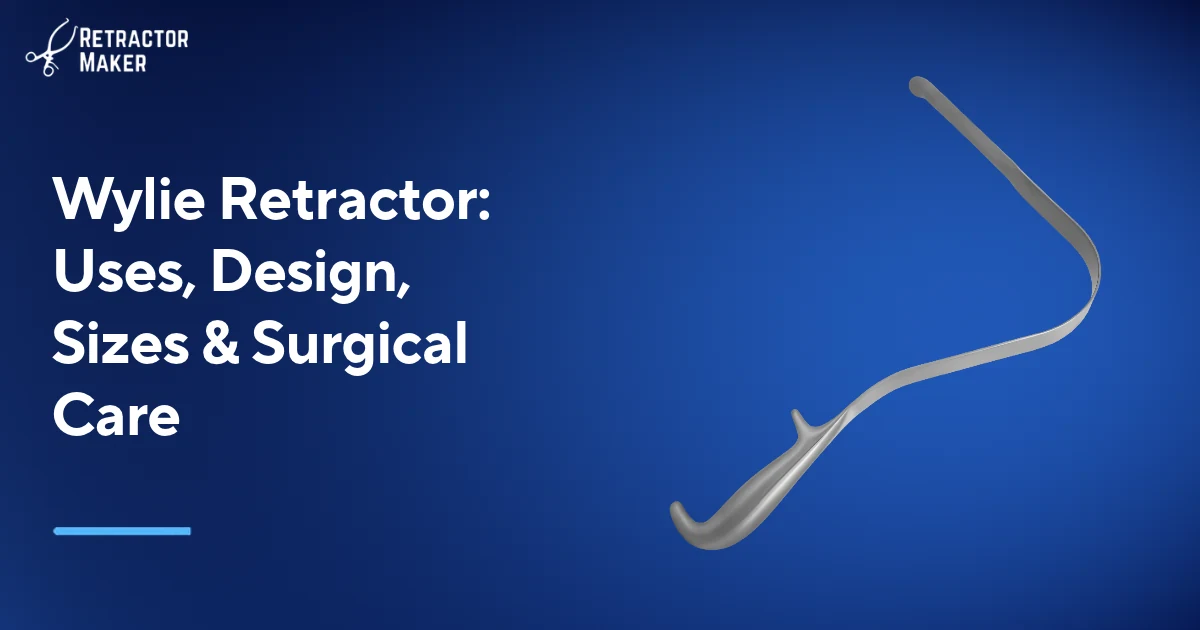
Learn about Wylie retractor uses, curved blade design, available lengths, safe handling, sterilization considerations, and purchasing from Retractor Maker.
Retractors discussed in this guide: Wylie Renal Vein Retractor. Browse all surgical retractors.
A Wylie retractor is a handheld vascular instrument designed to retract and protect the renal vein, vena cava, and major retroperitoneal vessels during vascular and urological surgery. The Wylie Renal Vein Retractor from Retractor Maker combines a deep-reach, single-end configuration with a curved vascular blade. For surgeons, its role is controlled exposure around major vessels; for operating room staff and buyers, the practical considerations include overall length, blade condition, grip, and preparation before use. It is supplied non-sterile and fully autoclavable, so delivery packaging does not make it ready for the sterile field.
What Is a Wylie Retractor?
The Wylie Renal Vein Retractor is a manually held instrument for maintaining exposure around deep vascular structures. Its intended function is retraction and protection, rather than clamping a vessel or controlling blood flow. The surgeon or assistant holds the instrument and adjusts its position as the operative field changes.
The term renal vein identifies a principal anatomical application, but the stated intended use also includes the vena cava and major retroperitoneal vessels. This distinguishes the instrument from a general wound-edge retractor. Selection should reflect the anatomy being exposed and the operating surgeon’s technique, not the product name alone.
What Is a Wylie Retractor Used For?
A Wylie retractor is used for vessel retraction and protection during vascular and urological surgery. Its curved blade supports exposure where the operative team needs access near the renal vein, vena cava, or other major retroperitoneal vessels. Appropriate use depends on direct assessment of the surgical field and the relationship between the blade and surrounding structures.
- Renal vein exposure: supporting access around the vein during relevant vascular or urological work.
- Vena cava exposure: retracting and protecting the vessel when required by the operative approach.
- Major retroperitoneal vessel exposure: helping maintain a working view around deep vascular anatomy.
- Instrument planning: identifying a dedicated vascular retraction option within the surgical team’s requested set.
The product is listed within cardiovascular, general surgery, and urology retractor categories. Those categories help with catalog navigation, but they do not establish suitability for every procedure in those specialties. Buyers should match the stated intended use to the surgeon’s requirements rather than assume broad interchangeability with other retractors.
How Are the Blade and Handle Designed?
The instrument has an anatomically curved vascular blade, a deep-reach single-end configuration, and an ergonomic flat handle. Its blade has smooth, rounded atraumatic borders intended to protect venous intima. These design features support its vessel-protection role, but atraumatic describes the border design rather than a guarantee against tissue injury.
Curved blade and tissue contact
The blade is the working portion that provides retraction. Before use, inspect its borders and surface for damage that could compromise smooth contact. No blade width, blade depth, or curvature measurement is supplied in the product specifications, so teams needing those details should request confirmation before ordering.
Handle and material
The ergonomic flat handle has lateral serrations for tactile grip stability. The stated material is Premium Grade AISI 304/316 Stainless Steel (Non-Magnetic). Material identification is relevant to procurement and processing records, but it does not replace the manufacturer’s instructions for cleaning, sterilization, inspection, or maintenance.
Which Wylie Retractor Sizes Are Available?
The supplied catalog describes one Wylie Renal Vein Retractor design with several overall-length variants. The table compares those options without implying differences in blade geometry. Listed prices are product reference prices; request a quotation to confirm the applicable currency, order terms, and shipping charges.
| Product and overall length | Design | Typical use | Listed price |
|---|---|---|---|
| Wylie Renal Vein Retractor — 11 ¾″ | Handheld deep-reach single-end curved vascular retractor | Renal vein, vena cava, and major retroperitoneal vessel retraction | $89.00 |
| Wylie Renal Vein Retractor — 12″ | Handheld deep-reach single-end curved vascular retractor | Renal vein, vena cava, and major retroperitoneal vessel retraction | $94.00 |
| Wylie Renal Vein Retractor — 12 ½″ | Handheld deep-reach single-end curved vascular retractor | Renal vein, vena cava, and major retroperitoneal vessel retraction | $99.00 |
| Wylie Renal Vein Retractor — 12 ¾″ | Handheld deep-reach single-end curved vascular retractor | Renal vein, vena cava, and major retroperitoneal vessel retraction | $104.00 |
| Wylie Renal Vein Retractor — 13″ | Handheld deep-reach single-end curved vascular retractor | Renal vein, vena cava, and major retroperitoneal vessel retraction | $109.00 |
Overall length is not the same as blade length or usable working depth. A longer instrument should not automatically be treated as a better choice for deeper exposure. The surgeon should consider access, hand position, and the available working space, while procurement staff should confirm any dimensions needed to match an existing instrument.
How Should a Wylie Retractor Be Positioned?
Positioning should be directed by the operating surgeon under direct visualization. This overview is not a substitute for surgical training or device instructions. The curved blade should be oriented for the intended exposure, with attention to adjacent vessels and tissues before retraction is applied.
Use only the retraction necessary to maintain the required view. Avoid blind placement, excessive traction, and using the blade as a lever against delicate anatomy. Smooth borders do not eliminate pressure-related injury, and the instrument should not be treated as a vascular clamp.
Because the retractor is handheld, communication between the surgeon and assistant is important. Reassess blade position and tissue response as the field changes, and adjust or release retraction when it is no longer needed. Before an assistant handover, confirm the desired position rather than assuming that continued pressure remains appropriate.
How Is a Wylie Retractor Cleaned and Sterilized?
The Wylie Renal Vein Retractor is supplied non-sterile and is fully autoclavable. It requires appropriate preparation and sterilization before surgical use. Individual Protective Packaging protects the supplied instrument during handling and storage; it should not be interpreted as sterile barrier packaging.
Obtain the manufacturer’s current reprocessing instructions before introducing the instrument into service. The supplied product information does not specify cleaning chemistry, steam-cycle temperature, exposure time, or drying parameters. Do not infer a validated cycle from the material description or the statement that the instrument is autoclavable.
- Manage used instruments according to facility procedures to limit soil drying before cleaning.
- Clean and inspect the blade, borders, and handle serrations before sterilization.
- Remove damaged instruments from service and follow the facility’s assessment process.
- Use the applicable manufacturer instructions and facility-validated sterilization workflow.
- Confirm processing completion and packaging integrity before release to the sterile field.
How Do You Choose and Buy from Retractor Maker?
Choose the overall length with the surgeon’s input and confirm any unlisted blade dimensions before purchase. For replacement instruments, compare the existing instrument’s specifications rather than relying on the Wylie name alone. Include sterile processing staff when reviewing reprocessing documentation and compatibility with the facility’s workflow.
Retractor Maker is a surgical retractor manufacturer and exporter in Sialkot, Pakistan, offering wholesale supply, OEM services, and worldwide shipping. The listed Wylie Renal Vein Retractor is brand new, supplied in Individual Protective Packaging, and has a minimum order quantity of 1 Piece.
For a quotation, specify the product name, required overall length, quantity, and delivery destination. Ask for current pricing, lead time, shipping terms, and available product documentation. For OEM enquiries, describe the requested requirements and obtain written confirmation of what can be supplied; do not assume unlisted modifications are standard options.
Clinical notice: This guide is for surgical teams and hospital buyers. Always follow the manufacturer's instructions for use (IFU) and your hospital's sterilization rules before clinical use.
Frequently Asked Questions
What is a Wylie retractor used for?
A Wylie retractor is used to retract and protect the renal vein, vena cava, and major retroperitoneal vessels during vascular and urological surgery. Its handheld curved blade supports exposure around these structures. It is intended for retraction and protection, not for clamping vessels or controlling blood flow.
Is a Wylie renal vein retractor self-retaining?
The listed Wylie Renal Vein Retractor is handheld, not self-retaining. Its configuration is a deep-reach single-end curved vascular retractor with an ergonomic flat handle and lateral serrations. A surgeon or assistant maintains its position and adjusts retraction as required by the operative field and the surgeon’s direction.
What sizes does the Wylie retractor come in?
The Wylie Renal Vein Retractor is available in overall lengths of 11 ¾″, 12″, 12 ½″, 12 ¾″, and 13″. These measurements describe overall length, not blade dimensions. If matching an existing surgical instrument, request confirmation of blade width, depth, and curvature because those measurements are not included in the supplied specifications.
Is the Wylie retractor supplied sterile?
The Wylie Renal Vein Retractor is supplied non-sterile and is fully autoclavable. It comes in Individual Protective Packaging, which should not be treated as sterile barrier packaging. Before surgical use, the instrument must undergo appropriate preparation and sterilization according to the manufacturer’s instructions and the facility’s validated processing workflow.
What material is the Wylie retractor made from?
The stated material is Premium Grade AISI 304/316 Stainless Steel (Non-Magnetic). The instrument also has a curved vascular blade with smooth, rounded atraumatic borders and a flat handle with lateral serrations. Buyers should retain the supplied material description in procurement records and request any additional documentation required by their facility.
Where can hospitals buy a Wylie renal vein retractor?
Hospitals can enquire directly with Retractor Maker, a surgical retractor manufacturer and exporter in Sialkot, Pakistan. The company offers wholesale supply, OEM services, and worldwide shipping. The listed minimum order quantity is 1 Piece; include the required length, quantity, and destination when requesting current pricing, documentation, and delivery terms.
About the author
Saad Shahid · Sales & Marketing Manager
Saad Shahid is the Sales & Marketing Manager and founder of Retractor Maker, started in 2023 in Sialkot, Pakistan. He also works with his father at Hospitech Traders, the family surgical instrument business founded in 1989.
Related Blogs & Guide

Related Retractors

Brunner Retractor
From $54.00
Weitlaner Retractor
From $94.00

Ring Breast Retractor With Fiber Optic Illumination
$339
Wide Self-Retaining Retractor
$139
Sauerbruch Retractor
From $69.00
Richardson Eastman Retractor
From $54.00
Need Surgical Retractors or Components?
Tell us what you need, including the product, configuration, quantity and destination country. Retractor Maker can provide availability, specifications and pricing.
Request a Quote