
Orthopedic & Spine Retractors
Phantom Retractor: Uses, Designs & System Selection
Author: Saad Shahid · Updated · 7 min read
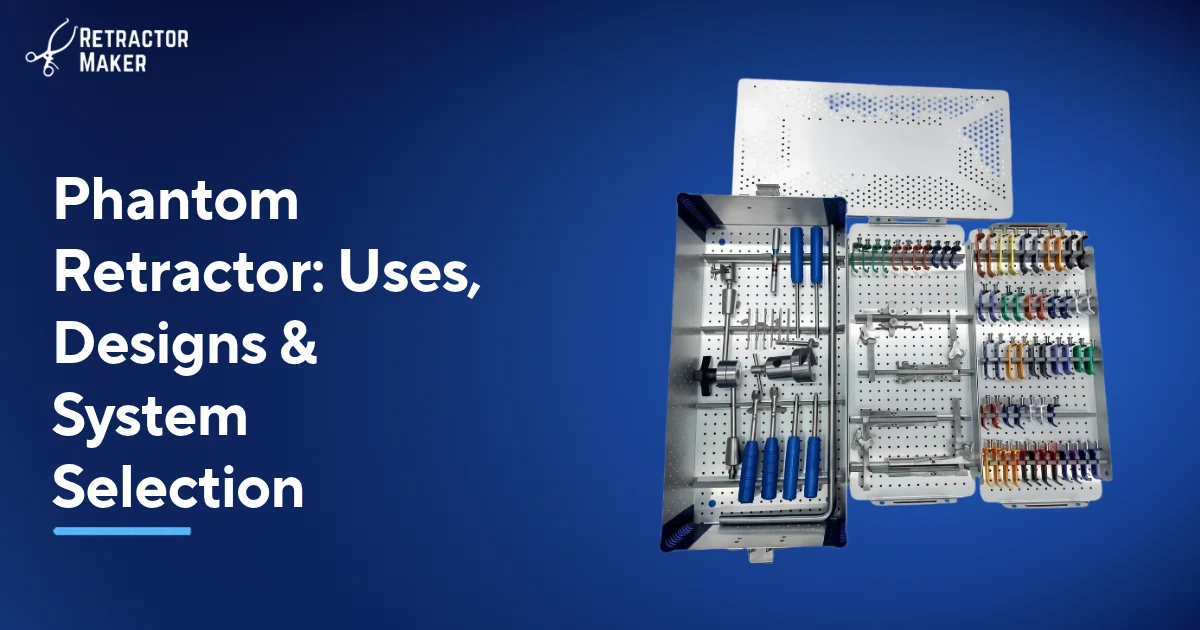
Compare phantom retractor systems for posterior lumbar, anterior lumbar and cervical access, with guidance on components, positioning, care and buying.
Retractors discussed in this guide: Phantom AL Anterior Lumbar Surgical Access System, Phantom ML MIS Lumbar Surgical Access System, Tedan Phantom CS-1600 Cervical Retractor Set. Browse all surgical retractors.
A phantom retractor is a spinal surgical access system that retracts soft tissues to maintain an operative corridor. The systems listed here serve different approaches: minimally invasive posterior lumbar access, anterior lumbar exposure and anterior cervical access with distraction instrumentation. For surgeons, OR staff and hospital buyers, the central distinction is the intended approach, not simply the product name. Selecting a system requires matching its framework, blades and supporting components to the planned procedure and the facility’s processing capabilities.
What is a phantom retractor?
A phantom retractor maintains exposure by holding selected tissues away from the surgical working area. Unlike a single handheld retractor, these products are supplied as complete systems or modular sets. Their components work together to establish and maintain access, although the method of support differs between configurations.
The Phantom ML uses a table-mounted pivoting framework, while the Phantom AL uses a table-mounted circular ring. The Tedan Phantom CS-1600 combines modular cervical blades and side-loading handles with Caspar-style distraction tools. These descriptions should not be treated as evidence that components are interchangeable. Compatibility must be confirmed for the specific set and any proposed replacement parts.
What is a phantom retractor used for?
Phantom retractor systems are used for approach-specific spinal exposure. The ML system provides controlled tissue retraction and illuminated access during minimally invasive posterior lumbar surgery. Sequential dilators and specialized blades help establish the surgical corridor, with fiber-optic LED illumination directed to the retractor.
The AL system provides stable, hands-free access and controlled soft tissue retraction during anterior lumbar interbody fusion, or ALIF. Its modular blades and pivoting holders support retroperitoneal exposure. The CS-1600 set is intended for soft-tissue retraction and vertebral body distraction during anterior cervical surgery, including anterior cervical discectomy and fusion, or ACDF.
- Posterior lumbar access: consider the ML system when the planned approach requires minimally invasive access and direct channel illumination.
- Anterior lumbar access: consider the AL system for ring-supported exposure during anterior approach lumbar procedures.
- Anterior cervical access: consider the CS-1600 for cervical soft-tissue retraction with Caspar-style distraction instrumentation.
How are the frameworks, blades and accessories designed?
Each system has an approach-specific design. The listed primary material for all three is Premium Grade AISI 304/316 Stainless Steel (Non-Magnetic). This material designation does not replace component-specific handling instructions or establish compatibility with other equipment.
Phantom ML framework and illumination
The ML frame has a top-load 250 mm rack base, independent pivoting blade arms and a side-load step-over retractor. Its complete configuration includes a table clamp, articulating arm, 7 hooks, 8 beveled blade pairs, 9 counter blades, 14 fan blades, dilators and obturators. Illumination comes from a tabletop LED light source and a 10 ft autoclavable fiber-optic light transmission cable.
Phantom AL ring and blade inventory
The AL system has a 300 mm outer diameter circular frame. Its 32 blades are 25 mm wide, with depths of 60, 80, 100, 120, 140, 160, 180 and 200 mm. The configuration includes 2 extension bars, 6 ring clamps, 6 pivoting holders, 2 support arms and 2 table clamps. Dual rotatable table clamps attach to operating table side rails.
CS-1600 cervical blades and instruments
The CS-1600 includes 42 blades: 20 blunt-edge blades measuring 30–75 mm, 12 micro-blunt blades measuring 35–60 mm, 8 long-toothed blades measuring 30–65 mm and 2 paddle blades. Its 2 side-loading handles use twist-release blade engagement. Supporting instruments include a twist drill bit with starter handle, single and dual drill guides, 2 distraction screw drivers, a depth gauge, a gap caliper gauge and a guarded bone tamp.
Which phantom retractor system matches the approach?
Choose between these variants by surgical approach before comparing blade inventories. They address different anatomical access requirements rather than representing progressively larger versions of the same instrument. The comparison below summarizes the supplied product descriptions.
| Product name | Design | Typical use |
|---|---|---|
| Phantom ML MIS Lumbar Surgical Access System | Table-mounted pivoting framework, sequential dilators, specialized blades and fiber-optic LED illumination | Controlled retraction and illuminated access during minimally invasive posterior lumbar surgery |
| Phantom AL Anterior Lumbar Surgical Access System | Table-mounted circular ring, modular blades and pivoting holders | Hands-free access and controlled soft tissue retraction during ALIF and anterior lumbar exposure |
| Tedan Phantom CS-1600 Cervical Retractor Set | Modular cervical blades, twist-release side-loading handles and Caspar-style distraction tools | Soft-tissue retraction and vertebral body distraction during anterior cervical surgery, including ACDF |
The supplied specifications identify illumination for the ML system, not for the AL or CS-1600. Similarly, table-mounted support is specified for the lumbar systems, while the cervical set lists retractor handles. Buyers should avoid assuming that a feature described for one product is included with another.
How should a phantom retractor be positioned?
Positioning must follow the selected system’s instructions and the operating surgeon’s approach-specific technique. These systems require trained surgical personnel; a product overview cannot provide a patient-specific placement sequence. Before use, confirm that the correct components are available, processed and functioning as intended.
For table-mounted systems, the team should verify attachment compatibility and secure support before loading the retractor. Blade selection should reflect the required exposure and the tissues being protected. Apply only the retraction necessary for access, avoid trapping vulnerable structures and reassess tissue pressure and blade position throughout the procedure.
Retraction and vertebral distraction are distinct functions. The CS-1600 distraction instruments require their own technique and checks rather than being treated as extensions of blade adjustment. With the ML system, route the illumination cable so that it does not interfere with access or compromise the sterile field, following the lighting equipment’s instructions.
How do you clean and sterilize phantom retractors?
All three systems are supplied non-sterile and require appropriate processing before use. Their specifications describe autoclavable systems, but the ML light unit is explicitly wipe-down and non-submersible. Do not interpret the system-level autoclavable description as permission to autoclave that light unit.
- Obtain the current component-specific cleaning, disassembly and sterilization instructions before processing.
- Clean instruments before sterilization, paying attention to blade connections, joints and other areas where soil can remain.
- Inspect components for damage and check moving mechanisms before assembling the set for processing.
- Use the manufacturer’s instructions and the facility’s validated protocol; do not infer cycle parameters from the material designation.
- Keep the ML light unit out of immersion processes and follow its separate wipe-down instructions.
The ML includes a Heavy-Duty Aluminum Sterilization Box with organizing tray, and the AL includes a Heavy-Duty Aluminum Sterilization Box. The CS-1600 includes a Heavy-Duty Custom-Fitted Organizational Sterilization Container Tray. Packaging supports organization but does not, by itself, establish a validated sterilization cycle.
How do you choose and buy from Retractor Maker?
Start with the operative approach, then verify the complete component list against the surgeon’s requirements. Review blade dimensions, mounting arrangements, illumination needs and processing instructions with both the OR and sterile processing teams. Confirm table-rail compatibility for lumbar systems rather than assuming every operating table accepts the supplied clamps.
Retractor Maker is a surgical retractor manufacturer and exporter in Sialkot, Pakistan, offering wholesale supply, OEM services and worldwide shipping. Each listed system is brand new and has a minimum order quantity of 1 Set. When requesting a quotation, specify the exact product name, destination, required configuration and any OEM requirements. Ask for current documentation, availability, shipping terms and confirmation of the supplied inventory before placing an order.
Clinical notice: This guide is for surgical teams and hospital buyers. Always follow the manufacturer's instructions for use (IFU) and your hospital's sterilization rules before clinical use.
Frequently Asked Questions
What is a phantom retractor used for?
A phantom retractor is used to maintain surgical exposure during approach-specific spine procedures. The Phantom ML supports minimally invasive posterior lumbar access with illumination, while the Phantom AL supports anterior lumbar exposure, including ALIF. The CS-1600 is intended for anterior cervical soft-tissue retraction and vertebral body distraction, including use during ACDF.
What is the difference between Phantom ML and Phantom AL?
Phantom ML is intended for minimally invasive posterior lumbar access, while Phantom AL is intended for anterior lumbar access. ML uses a pivoting framework, dilators and fiber-optic LED illumination. AL uses a 300 mm circular ring with modular blades and pivoting holders for stable, hands-free exposure during anterior lumbar procedures.
Which phantom retractor is used for ACDF?
The Tedan Phantom CS-1600 Cervical Retractor Set is intended for anterior cervical surgery, including ACDF. It combines modular retractor blades, twist-release side-loading handles and Caspar-style distraction instrumentation. Its listed inventory includes blunt-edge, micro-blunt, long-toothed and paddle blades. The surgeon must select components according to the planned exposure and applicable instructions.
Are phantom retractors supplied sterile?
The three listed phantom retractor systems are supplied non-sterile. They require cleaning and sterilization according to applicable manufacturer instructions and the facility’s validated protocol before use. Although the systems are described as autoclavable, the Phantom ML light unit is wipe-down and non-submersible and must be handled separately from autoclavable components.
What blade sizes are included with the Phantom AL?
The Phantom AL includes 32 blades that are 25 mm wide, with depths ranging from 60 to 200 mm. The listed depths are 60, 80, 100, 120, 140, 160, 180 and 200 mm. Blade selection depends on the required exposure and patient anatomy, not simply on choosing the longest available blade.
Where can hospitals buy phantom retractor systems?
Hospitals can request the listed phantom retractor systems from Retractor Maker in Sialkot, Pakistan. The manufacturer and exporter offers wholesale supply, OEM services and worldwide shipping, with a listed minimum order quantity of 1 Set per system. Buyers should confirm the exact configuration, processing documentation, compatibility requirements and shipping terms before ordering.
About the author
Saad Shahid · Sales & Marketing Manager
Saad Shahid is the Sales & Marketing Manager and founder of Retractor Maker, started in 2023 in Sialkot, Pakistan. He also works with his father at Hospitech Traders, the family surgical instrument business founded in 1989.
Related Blogs & Guide


Related Retractors

Mayfield Headrest
From $699Free Shipping
B-Z Weitlaner Retractor
$339
Fukuda Style Retractors
From $89.00
Weitlaner Retractor
From $94.00

Cervical Retractor Frame
From $109

Middledorpf Retractor
From $49.00
Need Surgical Retractors or Components?
Tell us what you need, including the product, configuration, quantity and destination country. Retractor Maker can provide availability, specifications and pricing.
Request a Quote