
General Surgery Retractors
Mathieu Retractor: Uses, Designs & Selection Guide
ผู้เขียน: Saad Shahid · อัปเดตล่าสุด · 7 นาทีในการอ่าน
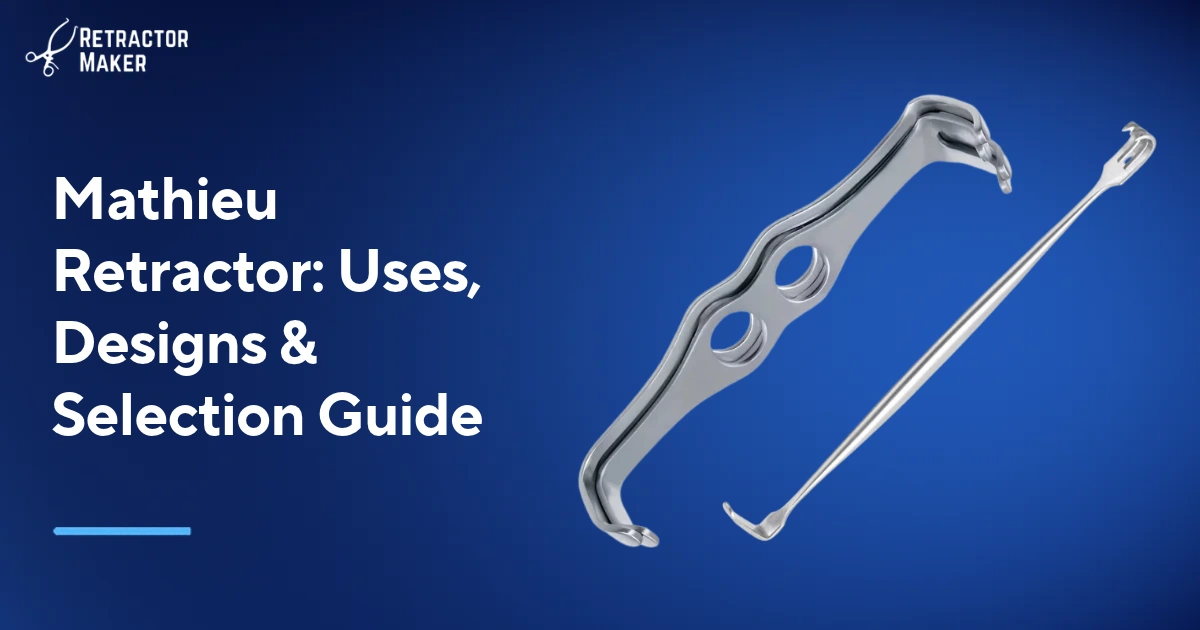
Learn Mathieu retractor uses, compare blade and finger designs, review handling and sterilization, and source wholesale or OEM instruments worldwide.
เครื่องถ่างแผลที่กล่าวถึงในคู่มือนี้: เครื่องถ่างแผล Mathieu, เครื่องถ่างนิ้วมือ Mathieu. ดูเครื่องถ่างแผลผ่าตัดทั้งหมด.
A Mathieu retractor is a handheld, double-ended surgical instrument used to hold back wound margins and soft tissues for operative exposure. The name covers distinct designs in the Retractor Maker catalogue: the Mathieu Retractor with bifurcated blades and the Mathieu Finger Retractor with rake-style working ends. Selecting between them starts with the tissue being retracted, the depth of exposure, and the intended surgical approach. This guide explains their differences for surgeons, operating room staff, and buyers preparing instrument specifications.
What is a Mathieu retractor?
The Mathieu Retractor is a manually held instrument for exposing skin margins, fascia, and other soft tissues across superficial and intermediate incisions. Its opposing right-angled bifurcated blades have smooth, rounded margins. Distinct blade geometries provide options for shallow subcutaneous retraction and deeper fascial elevation. The operator maintains the exposure through a flat central ergonomic handle.
The Mathieu Finger Retractor is a related but different instrument: a double-ended surgical rake with three prongs on each working end. It is intended for confined operative fields, including hand and finger surgery. Both designs rely on manual positioning rather than self-retaining action. Their shared name does not make them interchangeable, so instrument lists should identify the full product name and working-end design.
What is a Mathieu retractor used for?
Mathieu retractors support soft-tissue exposure in general, plastic, orthopedic, hand, and finger surgery, depending on the design selected. The bifurcated-blade model retracts wound margins and fascia, while the finger model elevates skin flaps and retracts cutaneous margins and tendons. Procedure names alone are not sufficient for selection; the planned tissue contact and access requirements matter.
- General surgery: the Mathieu Retractor is used for soft-tissue exposure during hernia and appendectomy procedures.
- Orthopedic access: the Mathieu Retractor supports muscular elevation and intermediate orthopedic access.
- Pelvic exposure: the Mathieu Retractor is used for intermediate pelvic access where its working ends suit the operative field.
- Hand and finger surgery: the Mathieu Finger Retractor exposes tissue in confined fields by retracting cutaneous margins and tendons.
- Plastic and minor general surgery: the Mathieu Finger Retractor supports skin flap elevation and soft-tissue exposure.
In each setting, retraction is an aid to visualization and access rather than a substitute for careful tissue handling. The surgical team should select the instrument within the context of the procedure and surrounding anatomy. Neither model should be chosen solely because it appears on a general specialty instrument list.
How do the design and parts affect handling?
The working ends determine tissue engagement, while the central handle supports manual control. On the Mathieu Retractor, right-angled bifurcated blades with smooth, rounded margins provide the tissue-contact surfaces. Its different blade geometries accommodate shallow subcutaneous retraction and deeper fascial elevation. Rounded margins still require careful positioning and appropriate traction; they do not eliminate the possibility of tissue injury.
On the Mathieu Finger Retractor, each end has three prongs. Selectable blunt tips support gentle tissue manipulation, while sharp tips provide firm tissue engagement. The flat central handle has lateral serrations for tactile grip stability and manual leverage. Its double-ended layout allows changes in tissue retraction direction without exchanging instruments. Sharp and blunt configurations should be specified clearly when ordering.
Both products are handcrafted from Premium Grade AISI 304/316 Stainless Steel (Non-Magnetic) and have an anti-glare satin matte finish. These shared characteristics do not resolve the main selection question: whether the procedure calls for bifurcated blades or rake-style prongs. Buyers should assess working-end suitability separately from material and finish.
Which Mathieu retractor variants are available?
Retractor Maker lists two relevant products: the Mathieu Retractor and the Mathieu Finger Retractor. Their principal difference is the tissue-contact design. The comparison below uses the catalogue descriptions to distinguish their intended roles without implying that one is universally preferable.
| Product name | Design | Typical use |
|---|---|---|
| Mathieu Retractor | Handheld, double-ended instrument with opposing right-angled bifurcated blades, smooth rounded margins, and a flat central ergonomic handle. | Wound-margin and fascial retraction in general, plastic, and orthopedic surgery; hernia, appendectomy, muscular elevation, and intermediate pelvic or orthopedic access. |
| Mathieu Finger Retractor | Handheld, double-ended rake with three prongs at each end, selectable blunt or sharp tips, and a flat central handle with lateral serrations. | Skin flap elevation and retraction of cutaneous margins and tendons in hand, finger, plastic, and minor general surgical procedures. |
The supplied catalogue descriptions do not specify overall lengths or working-end dimensions. Avoid assuming dimensions from the product name or from another supplier's version. If tray compatibility or a particular exposure requirement depends on measurements, request confirmed specifications before approving an order.
How should a Mathieu retractor be positioned?
A Mathieu retractor should be positioned under direct visualization by trained surgical personnel, with controlled traction appropriate to the tissue and operative field. Confirm the intended working end before placement. For the finger design, verify whether blunt or sharp tips have been selected rather than treating both configurations as equivalent.
- Inspect the working ends and handle before use for damage or irregularities.
- Identify the tissue intended for retraction and avoid unintended engagement of adjacent structures.
- Apply only the traction needed for useful exposure, while observing the tissue response.
- Maintain communication between the surgeon and assistant as the exposure requirements change.
- Release tension before repositioning rather than dragging engaged tips across tissue.
Manual retraction requires ongoing attention to both exposure and tissue condition. Excessive force or prolonged pressure can injure tissue regardless of the instrument's finish or tip shape. Positioning should follow the surgeon's technique and local clinical protocols; a product description is not a procedure-specific operative instruction.
How do you clean and sterilize a Mathieu retractor?
Both Mathieu models are supplied non-sterile in individual protective packaging and are fully autoclavable. Protective packaging is not a sterile barrier for immediate surgical use. Before first use and after subsequent use, follow the manufacturer's reprocessing instructions and the facility's validated cleaning, inspection, packaging, and sterilization workflow.
Cleaning must precede sterilization. Pay attention to the spaces between prongs or bifurcated blades and to handle features where residue may remain. Inspect clean instruments for retained soil, damage, and surface changes before packaging. The catalogue does not provide cycle temperatures, exposure times, or detergent specifications; obtain the applicable instructions rather than inferring a cycle from the material alone. Store processed instruments according to facility policy.
How do you choose and buy from Retractor Maker?
Choose by working-end design first, then confirm the specifications needed for your clinical and procurement requirements. Request the Mathieu Retractor for the described bifurcated-blade pattern or the Mathieu Finger Retractor for the three-pronged rake pattern. For the finger model, include the requested blunt or sharp tip configuration in the enquiry.
Retractor Maker manufactures these instruments in Sialkot, Pakistan, and accepts wholesale, OEM, and distributor orders with worldwide shipping. A useful quotation request identifies the product, required quantity, tip preference where applicable, destination, and any OEM requirements. Ask for confirmed dimensions and reprocessing documentation before final approval. Hospitals, surgical centers, and distributors can then compare the documented specification against their instrument lists and purchasing requirements.
ข้อควรทราบทางคลินิก: คู่มือนี้จัดทำขึ้นสำหรับทีมผ่าตัดและผู้จัดซื้อของโรงพยาบาล โปรดปฏิบัติตามคำแนะนำการใช้งานของผู้ผลิต (IFU) และข้อกำหนดการทำให้ปราศจากเชื้อของโรงพยาบาลทุกครั้งก่อนใช้งานทางคลินิก
คำถามที่พบบ่อย
What is a Mathieu retractor used for?
A Mathieu retractor is used to expose wound margins and soft tissues during surgery. The bifurcated-blade model supports skin-margin and fascial retraction in general, plastic, and orthopedic procedures. The Mathieu Finger Retractor is used for skin flap elevation and retraction of cutaneous margins and tendons in confined fields, including hand and finger surgery.
What is the difference between a Mathieu Retractor and a Mathieu Finger Retractor?
The Mathieu Retractor has bifurcated blades, while the Mathieu Finger Retractor has three-pronged rake ends. The blade model accommodates shallow subcutaneous retraction and deeper fascial elevation. The finger model supports skin flap elevation and exposure in confined operative fields, with selectable blunt or sharp tips. Specify the full product name to avoid ordering the wrong pattern.
Does the Mathieu Finger Retractor have sharp or blunt tips?
The Mathieu Finger Retractor is available with selectable blunt or sharp tips. Blunt tips support gentle tissue manipulation, while sharp tips provide firm tissue engagement. Both require controlled handling appropriate to the tissue. Buyers should state the requested tip configuration and confirm it with the supplier before ordering.
Is a Mathieu retractor self-retaining?
The Mathieu retractors described here are handheld, not self-retaining. A surgeon or assistant maintains their position and traction manually through the central handle. Both have double-ended layouts, but that feature does not hold the wound open independently. The operator must continue observing the tissue and adjust or release traction as needed.
Can a Mathieu retractor be autoclaved?
Both Retractor Maker Mathieu models are fully autoclavable. They arrive non-sterile in individual protective packaging and require appropriate reprocessing before surgical use. Cleaning, inspection, packaging, and autoclaving should follow the manufacturer's instructions and the facility's validated workflow. The catalogue descriptions do not specify cycle parameters, so obtain those instructions before processing.
What sizes of Mathieu retractor are available?
The supplied catalogue descriptions do not list Mathieu retractor lengths or working-end dimensions. Request confirmed measurements for the specific blade or finger model before purchasing. Where dimensions affect tray fit or surgical selection, include those requirements in the enquiry rather than assuming that instruments sharing the Mathieu name have identical measurements.
Where can hospitals buy Mathieu retractors wholesale?
Hospitals can request wholesale Mathieu retractors from Retractor Maker in Sialkot, Pakistan. The manufacturer also accepts OEM and distributor orders and offers worldwide shipping. Include the exact product name, quantity, destination, and blunt or sharp tip preference where applicable. Confirm dimensions, reprocessing documentation, and any OEM requirements before approving the purchase.
เกี่ยวกับผู้เขียน
Saad Shahid · ผู้จัดการฝ่ายขายและการตลาด
ซาด ชาฮิด เป็นผู้จัดการฝ่ายขายและการตลาดและผู้ก่อตั้ง Retractor Maker ซึ่งเริ่มดำเนินกิจการในปี 2023 ที่เมืองเซียลโกต ประเทศปากีสถาน เขายังทำงานร่วมกับบิดาที่ Hospitech Traders ซึ่งเป็นธุรกิจเครื่องมือผ่าตัดของครอบครัวที่ก่อตั้งในปี 1989
บทความและคู่มือที่เกี่ยวข้อง
เครื่องถ่างแผลที่เกี่ยวข้อง
เครื่องถ่างแผลทั้งหมด


ต้องการเครื่องถ่างแผลผ่าตัดหรือส่วนประกอบใช่ไหม?
แจ้งความต้องการของคุณ โดยระบุผลิตภัณฑ์ รูปแบบการจัดชุด จำนวน และประเทศปลายทาง Retractor Maker พร้อมให้ข้อมูลความพร้อมในการจัดส่ง ข้อมูลจำเพาะ และราคา
ขอใบเสนอราคา