
ENT Retractors
Wullstein Retractor: Uses, Design & Buying Guide
작성자: Saad Shahid · 업데이트 · 7 분 소요
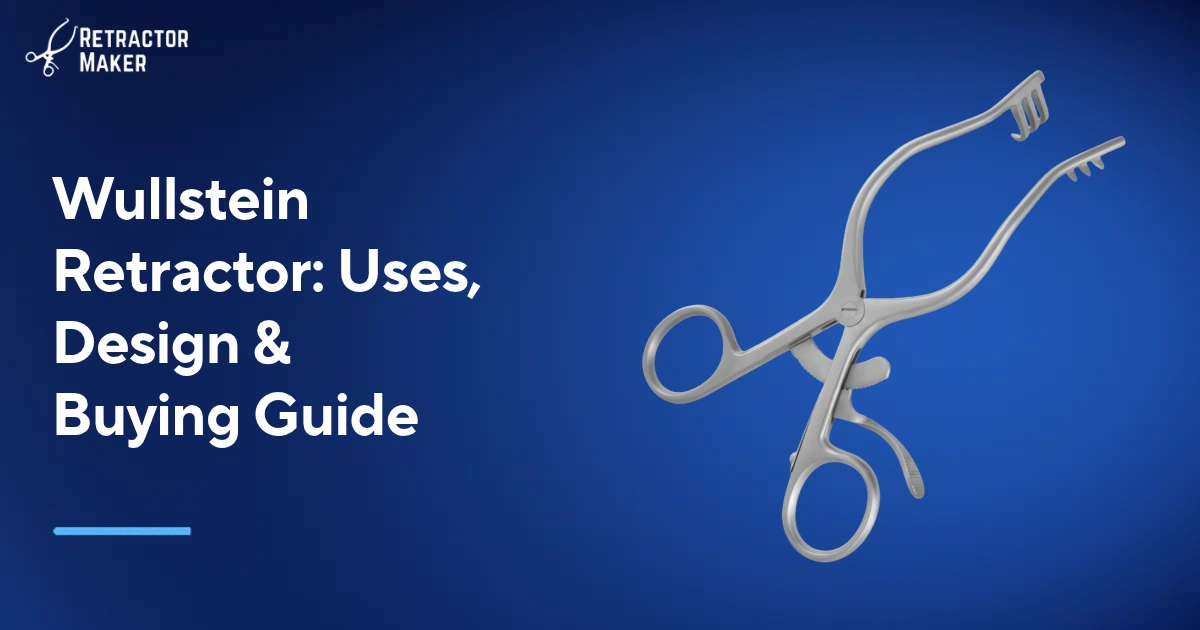
Learn about Wullstein retractor uses, jaw options, positioning, sterilization, and wholesale or OEM ordering from Retractor Manufacturer in Sialkot.
이 가이드에서 다루는 견인기: Wullstein Weitlaner 자가유지형 견인기. 모든 수술용 견인기 보기.
A Wullstein retractor is a self-retaining surgical instrument used to hold opposing wound margins and soft tissue apart during otologic and microsurgical procedures. Its locking mechanism maintains separation without continuous manual holding, helping preserve exposure in confined surgical corridors. Retractor Maker manufactures the Wullstein Weitlaner Self Retaining Retractor in Sialkot, Pakistan. For surgeons, operating room staff, and purchasing teams, the main selection considerations are jaw configuration, tip style, access to the operative field, and compatibility with the facility’s instrument processing requirements.
What Is a Wullstein Retractor?
The Wullstein Weitlaner Self Retaining Retractor provides hands-free wound-edge retraction after the surgeon positions the jaws and engages the ratchet. Unlike a handheld retractor that requires continuous support, a self-retaining instrument maintains its opening through a mechanical lock. This does not remove the need to monitor tissue contact, tension, or instrument position throughout the procedure.
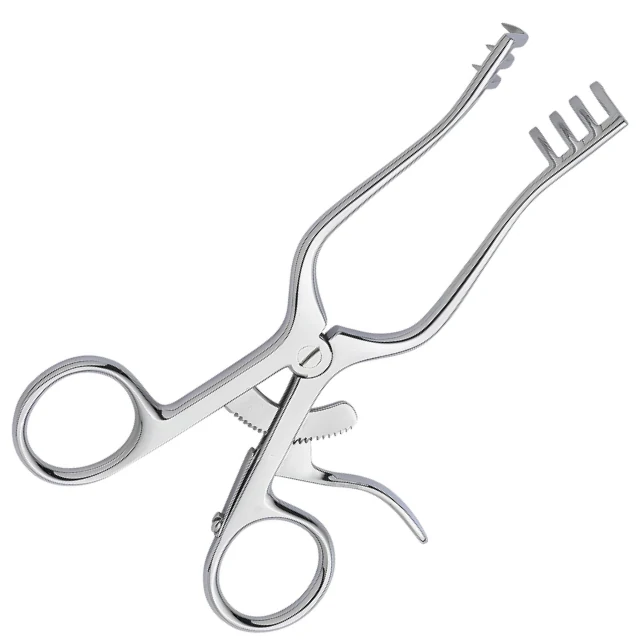
The catalogue model combines finger-ring handles, multi-prong jaws, and a multi-step mechanical ratchet catch. These features allow controlled separation and micro-adjustment of the wound edges. Its role is to maintain access rather than to cut, grasp for dissection, or replace other instruments needed in the field. In microscope-assisted work, positioning should preserve the viewing corridor while keeping the jaws and handles clear of necessary instrument movement.
What Is a Wullstein Retractor Used For?
The listed uses include ear, scalp, and minor surgery, with applications in ear, nose, and throat surgery, neurosurgery, and plastic reconstructive surgery. The instrument holds wound margins apart where stable soft-tissue exposure is needed, including operative fields viewed under an operating microscope. Suitability depends on the incision, tissue condition, and access requirements rather than the specialty name alone.
- Otologic procedures: maintaining wound-margin exposure in a confined ear-surgery field.
- Microsurgical procedures: supporting exposure while the operative field is viewed under magnification.
- Scalp and minor surgery: separating opposing wound edges when self-retaining retraction is appropriate.
- ENT, neurosurgical, and plastic reconstructive work: supporting selected soft-tissue exposure tasks according to surgical judgment.
These applications are not a recommendation for every procedure within those specialties. The operating surgeon must assess whether the jaws can engage suitable tissue without contacting vulnerable structures or applying excessive tension.
What Are Its Main Design Features and Parts?
The main components are finger-ring handles, multi-prong jaws, a ratchet catch, and a quick-release finger lever. The jaw configurations are straight or curved, and the tips are available sharp or blunt. Together, these features determine how the instrument is positioned, how it contacts tissue, and how separation is maintained.
Handles, locking mechanism, and release
Finger-ring handles provide the operating interface for opening and positioning the retractor. The multi-step mechanical ratchet catch maintains separation and allows micro-adjustment. A quick-release finger lever releases the lock. Before clinical use, staff should confirm that the ratchet engages reliably and that release is controlled, following the applicable manufacturer instructions and facility checks.
Material and surface finish
The instrument is handcrafted from Premium Grade AISI 304/316 Stainless Steel (Non-Magnetic). Its surface has an anti-glare satin matte finish. This finish is relevant to illuminated surgical fields, but it does not replace appropriate lighting adjustment or careful positioning under the operating microscope.
Which Wullstein Retractor Variants Are Available?
The supplied catalogue identifies one product with straight or curved jaw configurations and sharp or blunt tip options. These are configuration choices within the Wullstein Weitlaner Self Retaining Retractor listing, not separately documented instrument models. The table summarizes the listed product without assigning unsupported dimensions or procedure-specific specifications.
| Product name | Design and listed options | Typical use |
|---|---|---|
| Wullstein Weitlaner Self Retaining Retractor | Finger-ring handles; straight or curved multi-prong jaws; sharp or blunt tips; multi-step ratchet catch; quick-release finger lever | Hands-free wound-margin and soft-tissue retraction in otologic and microsurgical procedures, with listed applications in ear, scalp, and minor surgery |
Straight versus curved jaws should be considered in relation to the approach and clearance around the operative field. Sharp versus blunt tips should be selected according to the intended tissue contact and the surgeon’s requirements; blunt tips do not eliminate pressure injury risk. The supplied listing does not state overall length, jaw dimensions, or prong counts. Buyers should request those specifications before treating the instrument as a match for an existing tray item.
How Is a Wullstein Retractor Positioned?
A Wullstein retractor should be positioned by trained surgical personnel under direct visualization, using only the separation needed for adequate exposure. Placement depends on the operative approach and anatomy; a general overview cannot replace procedural training or the manufacturer’s instructions for use.
- Confirm that the selected jaw configuration and tip style suit the planned tissue contact.
- Check jaw alignment, ratchet function, and release operation before placement.
- Position the jaws on appropriate opposing wound margins while protecting nearby vulnerable structures.
- Increase separation gradually and confirm that engagement is stable without excessive tension.
- Reassess exposure and tissue contact during surgery, particularly after changes in patient or microscope position.
- Support the instrument and release tension in a controlled manner before repositioning or removal.
A locked ratchet should never be interpreted as proof of safe tissue loading. If exposure is inadequate, reassess placement and instrument suitability rather than simply increasing the opening.
How Should It Be Cleaned and Sterilized?
The Wullstein Weitlaner Self Retaining Retractor is supplied non-sterile in individual protective packaging and is fully autoclavable. Protective packaging is not a sterile barrier for clinical use. The instrument must undergo the facility’s required preparation and validated sterilization process before entering the sterile field.
Cleaning must precede sterilization. Staff should follow the manufacturer’s processing instructions and local protocols for handling, cleaning, rinsing, drying, inspection, and packaging. Particular attention is needed around the multi-prong jaws, moving interfaces, and ratchet, where retained soil can interfere with processing or function. Handle sharp-tip configurations with appropriate precautions.
The catalogue does not specify an autoclave cycle, detergent, or lubrication method, so these should not be inferred from the material description. Request the applicable reprocessing instructions. Remove instruments with damage, corrosion, misalignment, or unreliable locking from service for assessment rather than returning them directly to a surgical tray.
How Do You Choose and Order From Retractor Maker?
Choose the retractor by matching jaw configuration, tip style, and confirmed dimensions to the intended exposure task. For a replacement instrument, compare the existing tray requirement with a written specification rather than relying on the Wullstein name alone. Surgeon preference and sterile processing requirements should both inform purchasing.
Retractor Maker manufactures this instrument in Sialkot, Pakistan, and accepts wholesale, OEM, and distributor orders with worldwide shipping. A quote request should identify the Wullstein Weitlaner Self Retaining Retractor, the preferred straight or curved jaws, the required sharp or blunt tips, the order quantity, and the destination. For OEM orders, state the requested requirements and obtain confirmation of what can be supplied.
Before approving an order, request confirmation of dimensions, configuration availability, reprocessing instructions, and delivery arrangements. Keep the approved specification with purchasing and tray records so receiving staff can verify that the supplied instrument matches the clinical request.
임상 사용 시 유의사항: 이 가이드는 수술팀 및 병원 구매 담당자를 위한 자료입니다. 임상 사용 전에는 반드시 제조사의 사용 설명서 (IFU)와 해당 병원의 멸균 지침을 준수하십시오.
자주 묻는 질문
What is a Wullstein retractor used for?
A Wullstein retractor is used for self-retaining wound-margin and soft-tissue retraction in otologic and microsurgical procedures. The Retractor Maker listing includes ear, scalp, and minor surgery, with applications in ENT, neurosurgery, and plastic reconstructive surgery. Its suitability for a particular case depends on tissue condition, the surgical approach, and the exposure required.
Is a Wullstein retractor self-retaining?
The Wullstein Weitlaner Self Retaining Retractor maintains separation through a mechanical ratchet catch. Its multi-step lock allows micro-adjustment, and a quick-release finger lever releases the lock. Although continuous manual holding is unnecessary once it is positioned and locked, the surgical team must continue checking tissue tension, jaw contact, and instrument stability.
Does the Wullstein retractor have sharp or blunt tips?
The listed Wullstein Weitlaner Self Retaining Retractor is available with sharp or blunt tips. It also offers straight or curved jaw configurations. Tip selection should reflect the intended tissue contact and surgeon preference, with the requested configuration confirmed before ordering. Neither tip style removes the need to avoid excessive retraction pressure.
Can a Wullstein retractor be autoclaved?
The Retractor Maker Wullstein Weitlaner Self Retaining Retractor is fully autoclavable. It arrives non-sterile in individual protective packaging and requires appropriate processing before clinical use. The supplied catalogue does not provide sterilization cycle parameters, so the sterile processing team should obtain the applicable manufacturer instructions and use the facility’s validated process.
What sizes does the Wullstein retractor come in?
The supplied product listing does not specify Wullstein retractor dimensions or sizes. It identifies straight or curved jaws and sharp or blunt tips without stating overall length, jaw dimensions, or prong counts. Ask Retractor Maker to confirm these specifications before ordering, particularly when replacing an instrument in an established surgical tray.
Where can hospitals order Wullstein retractors wholesale?
Hospitals and distributors can request wholesale Wullstein retractor orders from Retractor Maker in Sialkot, Pakistan. The manufacturer also accepts OEM and distributor orders and offers worldwide shipping. Include the full product name, preferred jaw configuration, tip style, quantity, and destination in the inquiry, then confirm specifications and delivery arrangements before purchase.
작성자 소개
Saad Shahid · 영업 및 마케팅 책임자
사드 샤히드는 2023년 파키스탄 시알코트에서 설립된 Retractor Maker의 창립자이자 영업 및 마케팅 책임자입니다. 또한 1989년에 설립된 가족 경영 수술 기구 업체인 Hospitech Traders에서 아버지와 함께 일하고 있습니다.
관련 블로그 및 가이드
관련 견인기

Brunner 견인기
부터 $54.00
Weitlaner 견인기
부터 $94.00

광섬유 조명 일체형 링 유방 견인기
$339
광폭 자가유지형 견인기
$139
Sauerbruch 견인기
부터 $69.00
Richardson Eastman 견인기
부터 $54.00
수술용 견인기 또는 구성품이 필요하신가요?
제품, 구성, 수량 및 배송 국가를 포함하여 필요한 사항을 알려주세요. Retractor Maker에서 공급 가능 여부, 사양 및 가격을 안내해 드립니다.
견적 요청